This page compiles the full Nightsong rulebook into a clean A5 print layout. It is designed for browser print-to-PDF so players and GMs can generate a shareable offline copy with minimal extra formatting.
Table of Contents
Print Rulebook PDF
Download a generated PDF of the full rulebook. A fully designed layout edition is coming soon, but we are still finalizing the text at the moment so it is not ready for layout just yet.
About
Credits
Concept, Rules and Layout: René-Pier Deshaies-Gélinas
Illustrations: Galen Pejeau
Heroes: Andrew Boyd, Lynn Jones, Matteo Sciutteri, Xavier Tétreault, Gabriel Lemire, Louis-Philippe Déragon, Dominic Tremblay, Emmanuel Beauregard.
Support Nightsong
Commission Original Illustrations
Nightsong is free and always will be. But if you'd like to support the project, donations go directly toward commissioning original artwork from Galen Pejeau for the rulebook.
Miscellaneous
- Heading text font: Skema Pro Display
- Body text font: Candara
- Table entry font: Roboto Condensed
Inspirations
While designing Nightsong, we drew inspiration from many games, books, films, and other media, including:
Games
- MÖRK BORG, by Pelle Nilsson and Johan Nohr
- Into the Odd, by Chris McDowall
- The Black Hack, by David Black
- Mausritter, by Isaac Williams
- Shadowdark, by Kelsey Dionne
- Cairn, by Yochai Gal
Video Games
- Ori and the Blind Forest, Moon Studios
- Child of Light, Ubisoft Montreal
- Hollow Knight, Team Cherry
- Guild Wars, ArenaNet
Films & Series
- Avatar: The Last Airbender, Nickelodeon
- Wolfwalkers, Cartoon Saloon
- Princess Mononoke, Studio Ghibli
- Onward, Pixar
License
Nightsong is released under an open license. You are free to use it to create your own game built on its rules or to develop compatible third-party material.
Attribution Text
If you use our Licensed Material in your own published work, please credit us in your product as follows:
This product is based on Nightsong, published by Fari RPGs (https://farirpgs.com/), developed and authored by René-Pier Deshaies-Gélinas, and is licensed for use under the Open RPG Creative License. This product is licensed under the ORC License held in the Library of Congress at TX 9-307-067 and available online at various locations including www.azoralaw.com/orclicense and others. All warranties are disclaimed as set forth therein.
Overview
Finally, You’re Awake
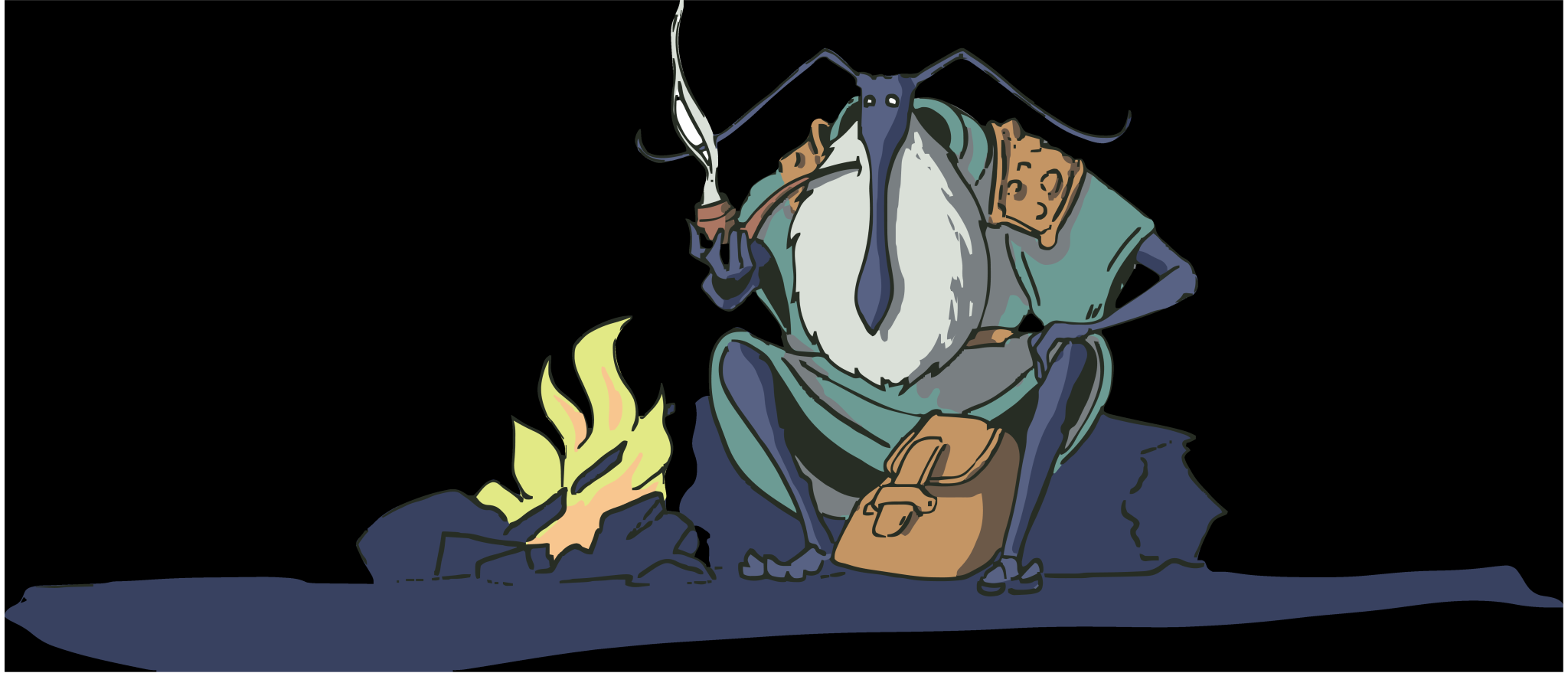
“Good, very good. I’ve been waiting quite a while for you now.
At first glance, I thought your cocoon was an empty shell as I opened the hatch to the room. Don’t get me wrong, I’m happy, just a bit surprised!
These carvings are quite damaged so I’m not sure for how long you’ve been wrapped here. It’s alright, it doesn’t matter. You can call me Quercus.
Let me get you up to speed. To be quite honest, your eyes open at this land’s final moment. A tale told in twilight, if you’ll pardon my poetic soul.
The land of Penumbra is a rotting corpse, but most don’t realize it yet. Or maybe they simply close their eyes to the blatant facts.
Two of the six Beacons that guide the dead through the Veil have been extinguished by beast knows what. Countless soulless Hollowed shells wander and screech in utter despair.
To make things worse, all the Firelight cocoons have withered and decayed, so there is just no hope of relighting the Beacons at all. No hope for the dead, no hope for us. Alveari, the stronghold beehive city of the Dominion, is crumbling and filled with simmering tension in the wake of the Queen’s recent passing.
To top it all, the Beast-Gods don’t sing in the dream of dreams no more. Let me tell you and believe me when I say that without their chants, flying through the Voidways is one nasty business.
So yeah, things aren’t great.
My boss spent a lot of amber chips on this expedition, but they sure as dusk didn’t expect I’d find one of you still buzzing after all this time, so you’re free to go.
I won’t tell anyone about you. Your secret is safe with me.
C’h Alwodina, friend.
Oh, before I forget, what is your chord in Nightsong?“
What Is This
Nightsong is a fantasy adventure game of heroism, friendship, and mystery set in Penumbra, a beautiful and crumbling world of rootmasses, fungal sprawl, crystal spires, drifting leaf isles, and sky-spanning Voidways filled with sentient bug-folk of countless kinds.
The characters are freeblades, wanderers bound to no hive or guild, who have woken from a long slumber into a land of wonders and dangers.
Penumbra is filled with dangers. Two of the six Beacons guiding the dead through the Veil are gone, and as such many Hollowed shells wander in despair. The Beast-Gods no longer sing their protective verses over the Oros. The Firelight cocoons have withered, so relighting the Beacons is impossible, and shadowy entities called Curses spread chaos, corruption, and fear. But, what remains is still beautiful, and radiant. It just may not last for very long.
This game is made of two parts.
First, it is a game meant to be played through a set of rules, systems, and procedures made for playing either as a solo game, as a duet with one other player, or as a group.
Second, it is a breathing, living world. Penumbra existed before you started playing and will continue to do so long after you are done with it.
The setting can be used as-is, modified, or set aside entirely in favor of a world of your own making. The mechanics and procedures will support your story regardless.
A Game of Nightsong
Traveling the land of Penumbra, the characters will:
- Wake into a dying age. The world is not safe. The dead lose their way, Beacons fail, and entire regions strain under slow collapse.
- Travel between bright places. Hive-cities, undergrowth tunnels, drifting isles, and ramshackle outposts still cling to life across a vast and beautiful land.
- Follow wonder and ruin together. Penumbra is full of ancient mysteries, and small fragile communities worth protecting.
- Choose their own allegiances. Freeblades answer to no one but themselves. What matters, and who matters, is up to them.
- Leave a mark on the world. Every decision, friendship, risk, and loss becomes part of the song that outlasts them.
At the table, players will:
How To Play
The goal of a game of Nightsong is to explore a fictional world, watch an emergent story take shape over time, and have fun while doing it.
Every player except one controls a player character and chooses what that character thinks, feels, says, and does. The world then reacts and evolves based on those actions.
The remaining player is the Referee, the neutral voice of the world. The Referee describes the places the characters visit and portrays the non-player characters (NPCs) they encounter. The Referee is also responsible for presenting problems and opportunities to the player characters, making the world react to their actions, and deciding when the rules come into play and how they should be interpreted. It is the Referee’s job to challenge the characters and put obstacles in their path, forcing them to show what they are made of. That being said, it is not the Referee’s job to decide how the story ends; that is what play is for! We play to find out what happens.
When playing solo, a single player fills both roles, leaning on the Referee’s tools and oracle tables to answer questions the Referee would normally arbitrate. In a duet game, one player can serve as the Referee while the other controls a single character, or both players can share the two roles, trading off as the fiction demands.
At its core, this game is a conversation. The Referee sets a scene, players ask questions and declare their character’s actions, the outcomes of those actions are resolved through fiction directly or handled via mechanics. The world then shifts in response, the conversation picks back up, and the cycle continues.
This game is rather light on rules, but new games or rules can still be intimidating. Players and the Referee do not need to memorize every rule before the first session. A cheat sheet is included with this game covering the essentials. If a rule is forgotten, ignore it or invent one on the spot, then look it up later. This will not ruin the game. What matters is that the story keeps moving and everyone at the table is having a good time.
Dice
This game uses polyhedral dice. They are written as D followed by a number indicating which die to roll. D4 is a four-sided die, D6 is a six-sided die, and so on. A number before the D means roll multiple dice and add the results together. 2D6 means roll two six-sided dice and sum them.
Each die type has a distinct role in the game:
- D20: This die is used for Ability Checks, testing a character’s prowess against difficult challenges.
- D4 to D12: These dice are used for Damage or Armor rolls during combat encounters. They are also used as “Step Dice”, a rule used to track anything that can be used up, wear out, run down, or draw near. For example, things like dwindling resources, consumables and faction goals.
- D%: This die is used as a Die of Fate, a rule that acts as an oracle for answering questions about the fiction when the player characters are not directly involved in the outcome. Note that in this case, we are talking about individual percentile die (labeled 10, 20, 30, … 90, 00, where 00 represents 100), not the combined D10 + D% roll you may have seen or used in other games.
- D66: These dice are used to draw results from the various rolling tables and generators in the game. To roll a D66, you roll a D6 twice. The first roll is the tens digit, the second is the ones digit. Results range from 11 to 66, for a total of 36 possible outcomes.
Play Materials
When playing in person, each player needs a printed copy of the character sheet, a set of polyhedral dice, and a pencil with an eraser. The Referee needs the same, along with a printed copy of the game’s cheat sheet.
When playing online, digital and interactive versions of the character sheet, cheat sheet, dice roller, and more are available on the resources page at https://farirpgs.com/nightsong/resources/.
Rulings
The rules in this game are very hackable, but will not cover every situation you may encounter. Bend them, break them, rebuild them to suit your table. This game is yours, so consider this our full permission to make it your own.
You are also encouraged to publish your own material, whether compatible (“Designed for use with Nightsong”) or derived from it (“Powered by Nightsong”). For more on this topic, visit https://farirpgs.com/nightsong/license.
High-resolution Nightsong branding assets are also available at https://farirpgs.com/nightsong/logos.
The Nightsong Rulebook
The complete rulebook contains everything needed to play in Penumbra or a world of your own making. It is organized into the following chapters.
- Introduction. The game’s core premise, play structure, and table roles.
- Setting. The major truths that define Penumbra and life within it.
- Character Creation. The full process for creating a freeblade and preparing for play.
- Rules. The mechanics that resolve uncertainty, conflict, and consequence.
- Procedures. The gameplay loops that structure moment-to-moment adventuring.
- Bestiary. The threats, foes, and entities that shape the game’s dangers.
- Guidelines. Practical direction for running the game and adapting outside material.
Now, let’s get started, shall we?
The World of Penumbra
This game does not include a full accounting of the world of Penumbra, nor does it matter. What follows are basic truths and foundations upon which to build your game.
The rest is either hinted at through the game text, rolling tables, rules, etc. or deliberately left unwritten. Gaps exist by design so you may fill them as you see fit.
Each story within Penumbra is going to be different and that is the goal. Take these truths starting points and make this your world.
Penumbra
Penumbra is a living continent of rootmasses, fungal sprawl, crystal spines, hive husks, and drifting leaf isles.
The Six Regions
The Wildgrove, with its deep Undergrowth labyrinth, makes up most of the land. The Arid Wastes sear the far east. The Amber Peaks split the continent. Beyond them stretches the pale Moonlight Desert, and farther yet the Thousand Isles fill the Forever Sea.
Oros
Penumbra is home to the Oros, sentient bug-folk of every shape and scale. Some talk or understand more than others. Some feed on others, a natural order that is both wondrous and cruel.
The Dream of Dreams
A vast symphony of ever-expanding collective consciousness spun by Arach, first of the Beast-Gods. It ties every Oros, plant, fungus, and beast in one shared existence and thread.
Thoughts begin as faint whispers in the dream, growing stronger as they are shared and repeated, until they become lasting patterns woven into the collective memory of everyone and everything.
For most Oros, the dream of dreams is just noise, with only the most universally accepted and compelling ideas emerging clearly enough to be understood by all.
As such, very few are those who have the ability to truly listen and draw from it guidance, knowledge and power. While all Oros are born of the dream, each retains their own will, identity, and distinct voice.
The dream does not exert control over their being; it is a force that can be drawn upon, not a master that commands them.
The Nightsong
The first chord strung in the dream of dreams. A living ledger of every true name and every life, holding each beginning and end that has ever happened over time.
Beast-Gods
The Oros revere or fear the Beast-Gods, gargantuan beings who carved the world, and breathed life into the lands. They are countless, but most know of: Arach, who wove the dream; Zephyr and Sylvary, who shaped the land; Nibel and Terrauk, who raised the Beacons; Mortueus, who gave form to life; and Aurel and Umbra, who granted them purpose.
These gods walk the world, vast and powerful, but have just recently stopped singing their protective verses in the dream of dreams.
The Veil
A luminous boundary between life and what lies beyond. When an Oros dies, their soul glows and seeks a Beacon to pass through the other side. Those who get lost become Hollowed, trapped in the world but severed from purpose.
The Beacons
Six soul-towers were raised by the Beast-Gods to pierce the Veil and guide the dead home, but two now stand dark. Each tower depends on a Firelight guardian to tend its flame, but every Firelight cocoon has withered and no new guardian can be born. As the towers fail, fewer souls find their way, and more become Hollowed.
The Hollowed
Souls who never reached the Veil. Their bodies remain, either inert, wandering, or corrupted.
Communication
Each kind of Oros has their own way of communicating. When they need to speak across kinds, they sing chords: clusters of musical notes sung, using the full spectrum of sound to express thoughts, emotions, and ideas.
It is assumed that when players speak on behalf of their characters, those words are sung within the fictional world. There is no need to sing them aloud in real life.
Home
While many prefer the relative safety of the hive-cities, the tunnels of the Undergrowth, or even the ramshackle Voidways outposts, there are still a lot of Oros who find a strong enough leaf or sturdy enough pebble and call it home.
Look close and you will find that life is everywhere and nothing stays still for very long.
Amber Chips
The amber chip, or just “chip”, is the main currency of Penumbra; it is a bright gold token of trade used to acquire food, supplies, and the comfort of a night’s rest away from the heavy drips of rain or the cold bite of the winds.
Spell Shards
Magic in Penumbra draws from the power and verses etched into spell shards; rare artifacts carved with Wormscript, the old and cryptic tongue of the Undergrowth. Once depleted, only those with a presence strong enough can give a shard the power to resonate once more.
Voidways
Penumbra is of unimaginable scale; traveling from one city to another can take years, even with steadfast ground mounts.
Because of this, many ride atop colossal Oros flyers, soaring through the Voidways to sail the ocean of shimmering dreamlines stretching across the sky. But without the Beast-Gods’ chants, shadows and Curses now hunt the flying lanes, making traveling vast distances ever more dangerous.
Curses
There are vast beings in the world, entities of unimaginable scale, powerful and terrifying. Most scarcely notice the Oros at all, viewing them as insignificant ripples in their far greater existence. Not Curses, though.
Curses are terrifying shadowy entities that have begun to spread across the land, corrupting everything they touch. They have extinguished two of the six Beacons, severing the passage of the dead through the Veil, and are also among the hunters that stalk the Voidways travel lanes.
No means known to the Oros seems to have a lasting effect on them, and because of this, many believe that Penumbra is facing its end: a slow descent into the forever night.
Rough Timeline
Penumbra knows two seasons: a warm, harvest-filled summer, then a swift drop into the total dark and cold of the long night. According to the archiver Quercus Eagar Ad’haow, the world is approaching its 893rd long night.
For most of that time, the great bee hives of the Alveari Empire were the bedrock of civilization, humming with life, literature, art, knowledge, industry, and near-total military dominance over the land.
Mere days before the characters emerged from their cocoons, the last Queen of the Alveari Empire died without an heir to follow her path.
New factions arose, borders were redrawn, and what the beefolk spent generations building is now in the process of being undone.
The World Forces
Three great forces now struggle for the future of Penumbra.
Each pursues its own goals by its own meansng. The freeblades move between the tension of these and many other world forces.
The Hivehold Remnant
Goal: Restore order and maintain the empire’s institutions, even without a Queen to lead them.
All of Penumbra knew the Queen was failing. For weeks, her sickness drew traders, pilgrims, and ambitious freeblades into the teeming streets of Alveari, each certain the end of her reign would crack open a door for them. Then one morning the Queen’s Guard climbed the palace spires and raised the red-black banner. Queen Magnalia had passed through the Veil with no brood-heir to succeed her.
The Hivehold Remnant is what remains of the Alveari Empire. They hold Alveari but by inertia.
Leading Questions
- Who truly controls Alveari in these trying times?
- Where and when will the Queen’s funeral be held?
- Which internal faction is willing to make a move while the city is paralyzed?
- Why is Iris, the Queen’s frail mother, always kept hidden from public view?
The Crystal Dynasty
Goal: Exploit the power vacuum left by the empire’s collapse to bring prosperity and dominance
Far off in the Moonlight Desert, countless Oros spent generations surviving in a land that wanted them dead. News of the Queen’s death reached them like lighthing. And so, and they began the grand migration, moving across Penumbra and leaving their old life behind.
Leading Questions
- What resource does the Dynasty control that the other forces desperately need?
- How far into the heartland have their agents already traveled?
- Which city or outpost have they quietly bought and not announced yet?
- What is the Dynasty willing to sacrifice to secure its foothold?
The Swarm
Goal: Tear down every throne, hive, and hierarchy, and replace them with nothing but freedom.
Unlike those who scrambled for power in the empire’s absence, the Swarm saw recent events as an awakening, a fateful return to the natural order. No queens. No councils. No lords.
The Swarm is led by faction chiefs who are loud and unpredictable. They are numerous, growing, and hold very strong beliefs in their hopes and dreams.
Leading Questions
- Which Swarm faction is making decisions the others do not know about yet?
- What act of destruction did the Swarm commit that they still justify to themselves?
- What does the Swarm want from the freeblades that they cannot get anywhere else?
- Where is the line between liberation and chaos, and has the Swarm already crossed it?
Freeform Character Creation
To create a character, go through the following steps.
There are two approaches to character creation.
Freeform characters build each part step by step using the rules and tables in this chapter. Path of the Beast-Gods characters use a ready-made presets with default Ability Scores, HP, Focus, Slots, starting belongings, Skills, etc.
1. Abilities
A character has four core Abilities that define their capabilities in different situations.
Strength represents might and power. This Ability also determines the number of Slots a character has for carrying items and bearing conditions.
Dexterity represents agility and finesse. This Ability also determines Focus, a reserve of effort and luck that can be spent to give a Check or Damage roll Advantage.
Presence represents willpower and charm. This Ability is used to resist the strain of casting Spells and determines how many Spell Shards a character can refill during a Long Rest.
Constitution represents toughness and resistance. This Ability determines starting Hit Points, a measure of the number of injuries a character can sustain before they die, and is used to resist fatigue, poison, and disease.
Distribute +2, +1, 0, and -1 among the Abilities, or roll 2D6 for each using the list below. If no score is +1 or higher, reroll all Abilities.
- On a 2, set the Ability score to -3.
- On a 3, set the Ability score to -2.
- On a 4 to 5, set the Ability score to -1.
- On a 6 to 8, set the Ability score to 0.
- On a 9 to 10, set the Ability score to +1.
- On an 11, set the Ability score to +2.
- On a 12, set the Ability score to +3.
2. Hit Points
Hit Points represent the number of injuries a character can sustain before they die. Set the character’s maximum Hit Points to Constitution + 6.
3. Focus
Focus is a reserve of effort and luck that can be spent to give a Check or Damage roll Advantage.
Each session, a character’s Focus is set to their Dexterity score, up to 3.
Unspent Focus is lost at the end of each session and does not carry over.
4. Slots
Slots measure how much a character can carry and how many Conditions they can bear. Set the character total Slots to Strength + 10.
Standard items take 1 Slot, bulky items take 2 Slots, and petty items take no Slots.
5. Origins
Oros come in countless forms. Some bear wings, others thick carapace, still others walk on eight legs with venom in their fangs. Every kind can be found across Penumbra, but where an Oros comes from shapes parts of who they are.
- Forma. Resilient wanderers of the Wildgrove’s thousand fallen hives with spirits that endure every hardship.
- Durus. Stout-hearted artisans of the Undergrowth with craft and kinship that will outlast their dwindling kin.
- Verdis. Curious guardians of the ancient Wellsprings with essence that stirs with old magic and the songs of seasons.
- Jotorn. Oathbound of the Amber Peaks with horned strength and spirit that honor the old hunt.
- Vespar. Ferocious hunters of the Arid Wastes with blade and tenacity forged in endless war campaigns.
- Tessera. Ingenious tinkers of the Thousand Isles with workshops that glow with impossible wonders.
6. Starting Belongings
Each character begins with common supplies and then chooses one of two methods for determining their starting belongings:
- Use the Character Tables to roll or pick a weapon, protection, and extra gear.
- Choose a Path of the Beast-Gods to take a ready-made package with Ability Scores, HP, Focus, starting belongings, Skills, and a name table.
If Presence is the character’s highest Ability, including when using a Path of the Beast-Gods, the character also begins with a number of Spell Shards equal to their Presence score. Each Spell Shard takes 1 Slot.
7. Details and Names
Roll or choose a name, and any personal details that define how the character looks and behaves. Note preferred pronouns. The character is ready to play.
Belongings
Every character starts with the following supplies:
- A bundle of torches (D6 Uses)
- Pack rations (D6 Uses, petty)
- 3D6 x 10 amber chips (petty)
Character Tables
When using the tables below, the player rolls on each table, then picks one option from the matching result.
Weapons 1D6
| 1D6 | Damage Tier | Options |
|---|---|---|
| 1-2 | D6 Weapon | throwing thorns / flint daggers / stone club / branch stick / sling |
| 3-4 | D8 Weapon | branch spear / flint sword / stone-head mace / flint axe / bow |
| 5-6 | D10 Weapon (bulky) | great stone hammer / hardened pike / oak greatclub |
Armor 1D6
| 1D6 | Result | Options |
|---|---|---|
| 1-3 | None | No armor, roll for one additional piece of gear |
| 4 | D4 Shield | seed pod |
| 5 | D4 Armor | layered bark / thick leaves |
| 6 | D6 Armor (bulky) | petrified wood |
Additional Gear 1D20 (3x)
| 1D20 | Additional Gear |
|---|---|
| 1 | Woven grass hammock |
| 2 | Vine rope, 50 feet |
| 3 | Thorn hook |
| 4 | Fungus lantern (D6 Uses) |
| 5 | Resin torch bundle (D4 Uses) |
| 6 | Sturdy twigs (D4 Uses) |
| 7 | Wooden stakes and a stone hammer |
| 8 | Cooking kit |
| 9 | Gourd canteen |
| 10 | Chalk and charcoal |
| 11 | Basic fishing kit |
| 12 | Climber's kit, vines and grips |
| 13 | Sturdy digging stick |
| 14 | Polished flint mirror |
| 15 | Healing herbs (D6 Uses) |
| 16 | Woven fiber clothes |
| 17 | Whetstone |
| 18 | Woodcarving toolbox |
| 19 | Vine snares (D4 Uses) |
| 20 | Waterproof leaf tarp |
Details
Once the mechanical side of the character is set, a few personal details bring them to life. The tables below cover appearance, personality, and names.
Origin Names
| 1D20 | Forma |
|---|---|
| 1 | Holly |
| 2 | Maple |
| 3 | Juniper |
| 4 | Briar |
| 5 | Rowan |
| 6 | Hazel |
| 7 | Cedar |
| 8 | Clover |
| 9 | Ash |
| 10 | Laurel |
| 11 | Sorrel |
| 12 | Willow |
| 13 | Bracken |
| 14 | Aspen |
| 15 | Tansy |
| 16 | Birch |
| 17 | Rue |
| 18 | Alder |
| 19 | Yarrow |
| 20 | Linden |
| 1D20 | Durus |
|---|---|
| 1 | Granite |
| 2 | Ember |
| 3 | Onyx |
| 4 | Clay |
| 5 | Slate |
| 6 | Cobalt |
| 7 | Forge |
| 8 | Jasper |
| 9 | Copper |
| 10 | Ash |
| 11 | Quartz |
| 12 | Mica |
| 13 | Iron |
| 14 | Pewter |
| 15 | Flint |
| 16 | Obsidian |
| 17 | Cinder |
| 18 | Ore |
| 19 | Coal |
| 20 | Shale |
| 1D20 | Verdis |
|---|---|
| 1 | Sage |
| 2 | Lily |
| 3 | Fennel |
| 4 | Brook |
| 5 | Moss |
| 6 | Cress |
| 7 | Iris |
| 8 | Basil |
| 9 | Rain |
| 10 | Thyme |
| 11 | Dew |
| 12 | Marjoram |
| 13 | Fern |
| 14 | Chive |
| 15 | Lotus |
| 16 | Anise |
| 17 | Mist |
| 18 | Reed |
| 19 | Parsley |
| 20 | Mint |
| 1D20 | Jotorn |
|---|---|
| 1 | Glacier |
| 2 | Ridge |
| 3 | Horn |
| 4 | Marble |
| 5 | Frost |
| 6 | Talus |
| 7 | Summit |
| 8 | Pike |
| 9 | Stone |
| 10 | Cairn |
| 11 | Scree |
| 12 | Alpine |
| 13 | Cliff |
| 14 | Lodestone |
| 15 | Boulder |
| 16 | Gneiss |
| 17 | Crest |
| 18 | Snow |
| 19 | Massif |
| 20 | Tor |
| 1D20 | Vespar |
|---|---|
| 1 | Ochre |
| 2 | Flare |
| 3 | Dune |
| 4 | Shimmer |
| 5 | Bronze |
| 6 | Sand |
| 7 | Ember |
| 8 | Sirocco |
| 9 | Glint |
| 10 | Rust |
| 11 | Amber |
| 12 | Haze |
| 13 | Scorch |
| 14 | Saffron |
| 15 | Dust |
| 16 | Copper |
| 17 | Mirage |
| 18 | Salt |
| 19 | Blaze |
| 20 | Cinder |
| 1D20 | Tessera |
|---|---|
| 1 | Gear |
| 2 | Pivot |
| 3 | Spindle |
| 4 | Hex |
| 5 | Ratchet |
| 6 | Fulcrum |
| 7 | Prism |
| 8 | Bolt |
| 9 | Cam |
| 10 | Lever |
| 11 | Spoke |
| 12 | Axis |
| 13 | Hinge |
| 14 | Facet |
| 15 | Pulley |
| 16 | Pinion |
| 17 | Spring |
| 18 | Gimbal |
| 19 | Rivet |
| 20 | Cog |
Detail Tables
Roll on or pick from any of the following tables. None of these choices affect the rules. They define who the character is at the start of their journey.
| 1D6 | Face |
|---|---|
| 1 | Round |
| 2 | Long |
| 3 | Wide |
| 4 | Plain |
| 5 | Lined |
| 6 | Scarred |
| 1D6 | Eyes |
|---|---|
| 1 | Piercing |
| 2 | Gentle |
| 3 | Cold |
| 4 | Weary |
| 5 | Bright |
| 6 | Distant |
| 1D6 | Physique |
|---|---|
| 1 | Slim |
| 2 | Stocky |
| 3 | Muscular |
| 4 | Heavy |
| 5 | Tall |
| 6 | Short |
| 1D6 | Clothing |
|---|---|
| 1 | Old |
| 2 | Fancy |
| 3 | Odd |
| 4 | Trendy |
| 5 | Dirty |
| 6 | Patched |
| 1D6 | Mannerism |
|---|---|
| 1 | Fidgets |
| 2 | Stares |
| 3 | Laughs often |
| 4 | Mumbles |
| 5 | Gestures |
| 6 | Never smiles |
| 1D6 | Speech |
|---|---|
| 1 | Loud |
| 2 | Mysterious |
| 3 | Slow |
| 4 | Fancy |
| 5 | Rough |
| 6 | Soft |
| 1D6 | Virtue |
|---|---|
| 1 | Brave |
| 2 | Patient |
| 3 | Kind |
| 4 | Loyal |
| 5 | Curious |
| 6 | Honest |
| 1D6 | Flaw |
|---|---|
| 1 | Proud |
| 2 | Greedy |
| 3 | Rash |
| 4 | Stubborn |
| 5 | Restless |
| 6 | Fearful |
| 1D6 | Drive |
|---|---|
| 1 | Freedom |
| 2 | Justice |
| 3 | Wealth |
| 4 | Revenge |
| 5 | Duty |
| 6 | Survival |
Spell Shards
Path of the Beast-Gods
Path of the Beast-Gods is an optional character creation process for groups that presets for their characters. They are somewhat akin to classes or backgrounds found in other role-playing games.
Each Path provides defaults for Ability Scores, HP, Focus, Slots, belongings, a list of Skills, and a name table.
The mechanics for using Skills are covered in the Rules chapter.
Terrauk’s Stoneclads
Unbreakable warriors who meet every threat with heart and grit.
- Ability Scores: Strength +2, Dexterity 0, Presence -1, Constitution +1
- HP: 7
- Focus: 0
- Slots: 12
- Starting Items
- Great stone hammer (D10 Weapon, bulky)
- Petrified wood (D6 Armor, bulky)
- Sturdy twigs (D4 Uses)
- Whetstone
- Sturdy digging stick
- A bundle of torches (D6 Uses)
- Pack rations (D6 Uses, petty)
- 3D6 x 10 amber chips (petty)
- Skills
Shield Wall D4:Roll your Armor Die twice and keep the higher result.Crushing Grip D4:Deal 1D12 Damage on an attack against an enemy that hurt you.Endure D4:Restore 1D6 HP.Defensive Stance D4:Attacks against you deal 1D4 Damage maximum for one Round.Charge D4:Deal 1D12 Damage and make the target skip their turn.Battle Cry D4:For 1D4 Rounds, step up your Damage Die by one size.
Names
| 1D6 | Stoneclad Name |
|---|---|
| 1 | Granite |
| 2 | Lodestone |
| 3 | Cairn |
| 4 | Rubble |
| 5 | Flint |
| 6 | Boulder |
Sylvary’s Wildsingers
Feral wardens who shape thorn and root along their loyal beast.
- Ability Scores: Strength -1, Dexterity +2, Presence +1, Constitution 0
- HP: 6
- Focus: 2
- Slots: 9
- Starting Items
- Bow (D8 Weapon)
- Layered bark (D4 Armor)
- Healing herbs (D6 Uses)
- Vine snares (D4 Uses)
- Basic fishing kit
- A bundle of torches (D6 Uses)
- Pack rations (D6 Uses, petty)
- 3D6 x 10 amber chips (petty)
- Skills
Thorncoat D8:Give your beast familiar temporary 1D4 Armor.Thorned Ground D6:Moving through this terrain deals 1D4 Damage and ignores Armor.Wild Shape D6:Become one with your familiar. Gain 1D6 HP and 1D8 natural attacks.Poison Strike D6:Your next attack inflicts poison for 1D4 Damage over 1D4 Rounds.Pack Tactics D4:You and your beast deal 1D12 Damage for one Round.Vines D6:The target has a 60% chance of becoming entangled for 1D4 Rounds.
Names
| 1D6 | Wildsinger Name |
|---|---|
| 1 | Briar |
| 2 | Fern |
| 3 | Thistle |
| 4 | Spore |
| 5 | Canopy |
| 6 | Tendril |
Naru’s Sanctars
Blessed champions who heal blight with radiance and faith.
- Ability Scores: Strength -1, Dexterity 0, Presence +2, Constitution +1
- HP: 7
- Focus: 0
- Slots: 9
- Starting Items
- Stone-head mace (D8 Weapon)
- Seed pod (D4 Shield)
- Fungus lantern (D6 Uses)
- Resin torch bundle (D4 Uses)
- Polished flint mirror
- A bundle of torches (D6 Uses)
- Pack rations (D6 Uses, petty)
- 3D6 x 10 amber chips (petty)
- Skills
Smite D6:Deal 1D12 Damage to undead, demons, and corrupted foes.Radiant Ward D4:An ally rolls their Armor Die twice and keeps the higher result for one Round.Purifying Light D6:Touch an ally to remove one of their Conditions.Holy Ground D4:Allies inside the area heal 1D4 HP on their turn for 1D4 Rounds.Banish D4:Deal 1D10 Damage. The target also has a 60% chance of being pushed away.Divine Shield D4:An ally ignores all Damage from the next attack against them.
Names
| 1D6 | Sanctar Name |
|---|---|
| 1 | Auris |
| 2 | Chalice |
| 3 | Vesper |
| 4 | Clarity |
| 5 | Lumen |
| 6 | Ward |
Mortueus’s Deathshrouds
Shadowed reapers who steal life to fuel their dark arts.
- Ability Scores: Strength -1, Dexterity +1, Presence +2, Constitution 0
- HP: 6
- Focus: 1
- Slots: 9
- Starting Items
- Flint sword (D8 Weapon)
- No armor
- Fungus lantern (D6 Uses)
- Chalk and charcoal
- Waterproof leaf tarp
- Woven grass hammock
- A bundle of torches (D6 Uses)
- Pack rations (D6 Uses, petty)
- 3D6 x 10 amber chips (petty)
- Skills
Life Drain D6:Restore 1D4 HP when an enemy drops to 0 HP.Shadow Cloak D4:Become invisible for one Round and gain Advantage on your next action.Decay Touch D4:Deal 1D6 Damage and inflict poison for 1D4 Damage over 1D4 Rounds.Raise Dead D4:Summon a corpse minion with 1D4 HP and 1D4 Damage.Siphon D4:Deal 1D4 Damage to the target, ignoring Armor, and restore that much HP.Dark Pact D4:Transfer one of your Conditions to an enemy within sight.
Names
| 1D6 | Deathshroud Name |
|---|---|
| 1 | Hollow |
| 2 | Dusk |
| 3 | Pall |
| 4 | Hush |
| 5 | Shroud |
| 6 | Veil |
Arach’s Dreamweavers
Arcane mystics who craft illusions and dreams.
- Ability Scores: Strength -1, Dexterity +1, Presence +2, Constitution 0
- HP: 6
- Focus: 1
- Slots: 9
- Starting Items
- Branch stick (D6 Weapon)
- Thick leaves (D4 Armor)
- Polished flint mirror
- Chalk and charcoal
- Woven fiber clothes
- A bundle of torches (D6 Uses)
- Pack rations (D6 Uses, petty)
- 3D6 x 10 amber chips (petty)
- Skills
Mind Spike D4:Deal 1D8 Damage to the target, ignoring Armor.Mirror Image D6:Create 1D4 illusions. Enemies have a 50% chance of mistaking them for you. Each absorbs one attack before vanishing.Dream Logic D4:Reroll any roll you or an ally made: Check, attack, Armor, or similar.Nightmare D4:The target has a 30% chance of being completely immobilized until hurt.Confusion D4:For 1D4 Rounds, the target has a 30% chance of hitting one of their allies.Shared Dream D4:Bind two allies together. Both gain Advantage on Checks and Damage rolls for 1D4 Rounds.
Names
| 1D6 | Dreamweaver Name |
|---|---|
| 1 | Silk |
| 2 | Murmur |
| 3 | Reverie |
| 4 | Lace |
| 5 | Stitch |
| 6 | Dusk |
Zephyr’s Stormcallers
Powerful invokers who hurl the elements without mercy.
- Ability Scores: Strength -1, Dexterity +1, Presence +2, Constitution 0
- HP: 6
- Focus: 1
- Slots: 9
- Starting Items
- Branch spear (D8 Weapon)
- Thick leaves (D4 Armor)
- Vine rope, 50 feet
- Gourd canteen
- Waterproof leaf tarp
- A bundle of torches (D6 Uses)
- Pack rations (D6 Uses, petty)
- 3D6 x 10 amber chips (petty)
- Skills
Lightning Arc D4:Deal 1D10 Damage to one target and 1D6 Damage to a second target.Wind Shield D4:Ranged attacks against you have Disadvantage until the next turn.Thunderclap D4:Nearby enemies have a 60% chance of losing their turn.Fireball D4:Deal 1D8 Damage to the target and 1D4 Damage to adjacent enemies.Stone Armor D4:Roll your Armor Die twice and keep the higher result for 1D4 Rounds.Blizzard D4:Targets inside the area have a 30% chance of losing their turn.
Names
| 1D6 | Stormcaller Name |
|---|---|
| 1 | Sirocco |
| 2 | Gale |
| 3 | Crackle |
| 4 | Squall |
| 5 | Arc |
| 6 | Surge |
Umbra’s Mistwalkers
Elusive rogues who strike in the spaces between heartbeats.
- Ability Scores: Strength 0, Dexterity +2, Presence +1, Constitution -1
- HP: 5
- Focus: 2
- Slots: 10
- Starting Items
- Flint daggers (D6 Weapon)
- No armor
- Vine rope, 50 feet
- Climber’s kit, vines and grips
- Chalk and charcoal
- Vine snares (D4 Uses)
- A bundle of torches (D6 Uses)
- Pack rations (D6 Uses, petty)
- 3D6 x 10 amber chips (petty)
- Skills
Smoke Bomb D6:Billow smoke for 1D4 Rounds. Attacks made inside it have Disadvantage.Death Blossom D4:Attack all adjacent enemies for 1D6 Damage each.Death Mark D4:Mark the target. When they reach half HP, deal 1D8 Damage to them.Stone Palm D4:The target has a 60% chance of skipping their turn.Vanish D4:Stay invisible until you attack and gain Advantage on your next action.Crippling Strike D4:Deal 1D6 Damage and reduce the target’s movement speed.
Names
| 1D6 | Mistwalker Name |
|---|---|
| 1 | Fade |
| 2 | Wisp |
| 3 | Slate |
| 4 | Haze |
| 5 | Cipher |
| 6 | Thread |
Toh’s Spiritbounds
Channelers who walk between mortal and ethereal realms.
- Ability Scores: Strength -1, Dexterity +1, Presence +2, Constitution 0
- HP: 6
- Focus: 1
- Slots: 9
- Starting Items
- Flint axe (D8 Weapon)
- Seed pod (D4 Shield)
- Fungus lantern (D6 Uses)
- Woven grass hammock
- Vine rope, 50 feet
- A bundle of torches (D6 Uses)
- Pack rations (D6 Uses, petty)
- 3D6 x 10 amber chips (petty)
- Skills
Ghost Walk D6:Become incorporeal for 1D4 Rounds. Ignore obstacles and Damage.Union Spirit D4:Summon a spirit with 4 HP that absorbs Damage meant for an ally.Pain Spirit D6:Summon a spirit with 4 HP that grants allies +1 Damage for 1D4 Rounds.Weapon of Wrath D4:Summon a spirit weapon that deals 1D10 Damage for 1D4 Rounds.Ethereal Strike D4:Deal 1D8 Damage, ignoring Armor.Spirit Ward D6:Enemies crossing your ward take 1D6 Damage.
Names
| 1D6 | Spiritbound Name |
|---|---|
| 1 | Echo |
| 2 | Vigil |
| 3 | Remnant |
| 4 | Toll |
| 5 | Pale |
| 6 | Weft |
Aurel’s Lightwardens
Luminous sentinels who shape pure light into shield and blade.
- Ability Scores: Strength -1, Dexterity +1, Presence +2, Constitution 0
- HP: 6
- Focus: 1
- Slots: 9
- Starting Items
- Stone-head mace (D8 Weapon)
- Seed pod (D4 Shield)
- Fungus lantern (D6 Uses)
- Healing herbs (D6 Uses)
- Polished flint mirror
- A bundle of torches (D6 Uses)
- Pack rations (D6 Uses, petty)
- 3D6 x 10 amber chips (petty)
- Skills
Blade of Dawn D4:Deal 1D10 Damage, ignoring Armor against shadow creatures.Beacon D6:Allies in your light zone gain Advantage for 1D4 Rounds.Searing Ray D4:Deal 1D8 Damage, then burn for 1D4 Damage over 1D4 Rounds.Jailed D4:The target has a 60% chance of being trapped for 1D4 Rounds.Healing Light D6:Touch an ally to restore 1D6 HP and remove one Condition.Radiant Burst D4:Enemies in the area take 1D6 Damage. Undead take 1D10.
Names
| 1D6 | Lightwarden Name |
|---|---|
| 1 | Auris |
| 2 | Gleam |
| 3 | Solace |
| 4 | Kindle |
| 5 | Dawnmark |
| 6 | Vigil |
Nibel’s Bloomsmiths
Ingenious cultivators who harvest and command the wild.
- Ability Scores: Strength +1, Dexterity 0, Presence +2, Constitution -1
- HP: 5
- Focus: 0
- Slots: 11
- Starting Items
- Flint axe (D8 Weapon)
- Layered bark (D4 Armor)
- Woodcarving toolbox
- Sturdy digging stick
- Healing herbs (D6 Uses)
- A bundle of torches (D6 Uses)
- Pack rations (D6 Uses, petty)
- 3D6 x 10 amber chips (petty)
- Skills
Bloom Turret D4:Plant a seedling turret with 1D8 HP and 1D6 Damage.Rapid Growth D6:Repair a broken Armor, Weapon, or Shield, stepping up Step Die.Volatile Spores D4:Your next hit deals 1D12 Damage and another 1D10 Damage the next Round.Pollen Cloud D4:Deal 1D4 Damage and give targets Disadvantage for 1 Round.Hardshell Fungi D6:Nearby allies gain 1D4 Armor for 1D4 Rounds.Thornbriar Field D4:Enemies moving through the field take 1D6 Damage.
Names
| 1D6 | Bloomsmith Name |
|---|---|
| 1 | Spindle |
| 2 | Ratchet |
| 3 | Cog |
| 4 | Pivot |
| 5 | Rivet |
| 6 | Filament |
Basics
Time
The game uses three scales of time.
Rounds: Each Round lasts less than 1 minute and tracks actions used during combat.
Turns: Each Turn lasts about 10 minutes and tracks actions used during exploration.
Watches: Each Watch lasts about 6 hours and tracks actions used during travel. Each day is divided into four Watches: morning, afternoon, evening, and night.
Step Dice
Step Dice track anything that can be used up, wear out, run down, or draw near. They follow a die chain from D12 down through D10, D8, D6, D4, and finally D0.
Roll a Step Die when a resource is used, an item is stressed, or time passes. Interpret the result as follows:
- On a 1, reduce the Step Die by two steps.
- On a 2 to 3, reduce the Step Die by one step.
- On a 4+, the Step Die stays the same.
At D0: The resource is spent, the item breaks, the timer runs out, or the situation changes, depending on what the die was tracking.
Step Dice can track items with limited uses:
- Bundle of healing herbs (D4)
- Quiver of arrows (D10)
- Rations (D6)
Step Dice can also track timers:
- How long a torch stays lit (D6)
- How long an oil lantern stays lit (D8)
- How soon before a dangerous creature catches up (D4)
- How close a certain faction is to reaching its goal (D6)
Characters
Abilities
A character has four core Abilities.
Strength: Represents might and power. It also determines how many Slots a character has for carrying items and bearing Conditions.
Dexterity: Represents agility and finesse. It also determines Focus, a reserve of effort and luck that can be spent to give a Check or Damage roll Advantage.
Presence: Represents willpower and charm. It is used to resist the strain of casting and determines how many Spell Shards a character can refill during a Long Rest.
Constitution: Represents toughness and endurance. It also determines starting Hit Points, and is used to resist fatigue, poison, and disease.
During character creation, distribute +2, +1, 0, and -1 among the Abilities, or roll 2D6 for each using the list below. If no score is +1 or higher, reroll all Abilities.
- On a 2, set the Ability score to -3.
- On a 3, set the Ability score to -2.
- On a 4 to 5, set the Ability score to -1.
- On a 6 to 8, set the Ability score to 0.
- On a 9 to 10, set the Ability score to +1.
- On an 11, set the Ability score to +2.
- On a 12, set the Ability score to +3.
Hit Points
Hit Points (HP) measure how many injuries a character can take before they die. When a character takes Damage, reduce their HP by that amount. At 0 HP or lower, the character is taken out and will die in a number of minutes (or Rounds) equal to Constitution + 1D4 unless they receive help.
During character creation, set maximum HP to Constitution + 6.
Death
When a character dies, the player creates a new character. The Referee introduces them to the group as soon as possible. Alternatively, the player may take over an NPC already traveling with the group.
Rests
When a character has time to pause and recover, they can take a Rest to refill lost HP and tend to Conditions. Resting takes time, and time may cost the group opportunities or attract danger. The type of Rest a character takes depends on how much time they have and what they need to recover from.
A Short Rest takes 10 minutes (one Turn) and refills 1D4 HP.
A Long Rest takes 6 hours (one Watch) and refills 1D6 HP. It also clears most minor Conditions such as fatigue, stress, or exhaustion, though some may still require a Remedy or specific action in the fiction.
A Full Rest takes one week and refills all HP. It also clears most major Conditions such as broken limbs, deep sickness, or lingering poisons, provided the character has access to shelter and care.
Remedies
A Remedy is any curative preparation, whether a potion, salve, herbal bundle, or similar material. A Remedy takes 1 Slot, and its uses are tracked with a Step Die.
Using a Remedy takes 10 minutes (one Turn). Afterward, roll 1D6 and recover that many HP.
- A common Remedy starts at D4.
- A well-crafted one starts at D6.
- A rare or powerful Remedy starts at D8 or higher.
Focus
Focus is a reserve of effort and luck that can be spent to give a Check or Damage roll Advantage. It refills each session to match a character’s Dexterity, up to a maximum of 3.
Spend: A character can spend 1 Focus to give a Check or Damage roll Advantage, even after seeing the result.
Refresh: Any unspent Focus is lost at the end of a game session.
Slots
A character has a number of Slots for tracking what they carry and the Conditions that hinder them. The following all take up Slots.
Items: An item is anything a character picks up, buys, or finds and keeps in their inventory. Most items take 1 Slot. Bulky items take 2, and petty items take none. Supplies such as torches or rations have uses tracked with a Step Die. At D0, the item is gone.
Weapons: A Weapon is anything used to deal Damage in combat. A Weapon’s quality is tracked with a Step Die and ranges from D4 to D12. Roll its die when attacking. After each combat encounter, players roll the Step Die of each Weapon their character used in the fight. At D0, the Weapon breaks and must be repaired or replaced.
Armor: Armor is the protective gear a character wears to reduce incoming Damage. An Armor’s quality is tracked with a Step Die and ranges from D4 to D6. When a character takes Damage, roll the Armor Die and subtract the result from the Damage. After each combat encounter, players roll the Step Die of the Armor their character wore in the fight. At D0, the Armor breaks and must be repaired or replaced.
Shields: A Shield is a piece of defensive equipment used to block and cancel the Damage of an entire attack. A Shield’s quality is tracked with a Step Die and ranges from D4 to D6. Unlike Weapons and Armor, a Shield’s Step Die is rolled after each use, not after a combat. At D0, the Shield breaks and must be repaired or replaced.
Conditions: A Condition is any affliction that hinders a character, such as fatigue, stress, broken limbs, poison, and more. Each Condition takes 1 Slot, but may take more if it worsens over time. If no Slot is available, the character must drop something to make room. A Condition may impose Disadvantage on certain actions or render them impossible. To clear a Condition, a character must rest or receive the appropriate care.
During character creation, set the total number of Slots to Strength + 10. If a character’s Strength increases through an Advancement, update the total number of Slots available.
Actions
Resolving Actions
When a player describes an action, the Referee looks to the fiction and decides whether the outcome is assured, uncertain, or impossible before any dice are rolled.
Assured: The character has the ability, tools, time, and opportunity, so the action simply happens.
Uncertain: The outcome is in doubt, the stakes matter, and so the Referee calls for a Check.
Impossible: The action cannot succeed as described. The Referee explains why to allow the player to try a different approach.
If a competent character has what they need and nothing meaningfully stands in the way, the action should simply unfold. Checks are for moments where the result is truly uncertain and the outcome will change the situation.
Checks
When the outcome of an action is uncertain, the Referee calls for a Check and sets a Difficulty Rating (DR).
- A DR of 6 is routine.
- A DR of 9 is easy.
- A DR of 12 is normal.
- A DR of 15 is difficult.
- A DR of 18 is extreme.
To make a Check, the player rolls 1D20 and adds the most relevant Ability score. If the total meets or exceeds the DR, the action succeeds. Otherwise, it fails.
When playing solo, always default to DR 12 unless the fiction clearly calls for something easier or harder.
Advantage: When factors in the fiction improve a character’s position, such as a clever plan, surprise, or an enemy’s weakness, the Referee may grant Advantage. When a Check has Advantage, roll 2D20 and keep the highest die.
Disadvantage: When the situation works against the character, such as darkness, harsh weather, a debilitating Condition, or firing into cover, the Referee may impose Disadvantage. When a Check has Disadvantage, roll 2D20 and keep the lowest die.
Helping: Before a Check is rolled, one nearby ally who could reasonably assist may help and grant Advantage to the acting character. The ally must be physically present and able to take part in the action, and only one ally can help on a given Check. An ally who helps shares the same risk and consequences as the character making the Check. In combat, helping costs the ally their action for that Round.
Opposed Checks: When two characters act directly against each other, both make a Check and the higher total wins. On a tie, roll again.
Nuanced Checks
When the Referee wants more than a binary result when making a Check, the player makes a Nuanced Check instead. Roll 2D20, add the most relevant Ability score to each die separately, and compare both totals to the DR.
- If both totals meet or exceed the DR, it is a strong success. The action succeeds cleanly, quickly, or with an added benefit.
- If only one total meets or exceeds the DR, it is a weak success. The action succeeds, but a cost, delay, reduced effect, exposure, or new complication follows.
- If neither total meets or exceeds the DR, it is a failure. The action does not go as intended, and the fiction moves forward with a consequence.
When playing solo, all Checks should be resolved as Nuanced Checks.
Advantage: When a Nuanced Check has Advantage, roll 3D20 and keep the highest two dice, then resolve the Nuanced Check normally.
Disadvantage: When a Nuanced Check has Disadvantage, roll 3D20 and keep the lowest two dice, then resolve the Nuanced Check normally.
Spells
Spell Shards: Each Spell is held in a Spell Shard. Its uses are tracked with a Step Die, and each Spell Shard takes 1 Slot.
Casting: Anyone can use magic, and Spells always take effect when cast. After casting, the caster must succeed a DR12 Presence Check or gain a “fatigued” Condition.
Recovery: After each cast, roll the Spell’s Step Die. At D0, the Spell is drained and can no longer be used. During a Long Rest, a character may refill a number of Spell Shards equal to their Presence score. When using Heroic Mode, that same recovery pool can also be used to refill Skills.
Skills
Skills: Skills are an optional rule for groups that want more special and mechanical-based abilities for their characters.
Gaining Skills: Outside of character creation, Skills are gained through training with an Avatar of a Beast-God at a shrine or sanctuary and completing its trials. To complete a Trial, a character must succeed at a series of Checks that test physical, mental, and spiritual limits. The Referee sets the number and DR of these Checks based on the Avatar’s domain. On completion, the character gains a Skill from that domain.
Slots: Each equipped Skill takes 1 Slot. When they are not equipped, they take none.
Switching Skills: A character may swap equipped Skills during a Short Rest.
Activation: To activate a Skill, roll its Step Die.
In Combat: Using a Skill does not count as the character’s Action unless the Skill says otherwise.
- On a 1, reduce the Skill’s Step Die by two steps.
- On a 2 to 3, reduce the Skill’s Step Die by one step.
- On a 4+, the Skill’s Step Die stays the same.
Effect: Skills always take effect and do not require a Check unless the Skill itself calls for one.
At D0: The Skill is drained.
Recovery: During a Long Rest, a character may recharge a number of Skills or Spell Shards equal to their Presence score.
The full list of Skills, organized by Path, is available in the Character Creation chapter. Feel free to create your own Skills.
Advancements
The Referee decides when characters receive an Advancement, typically after completing a quest, making a significant discovery, or bringing down a powerful foe.
When characters receive an Advancement:
- Add 1D4 to their maximum HP.
- Roll 1D6 for each Ability. If the result is higher than the Ability’s current score, increase it by 1.
- If Constitution increases, also increase maximum HP by 1.
- If Strength increases, update the total number of Slots available.
- If Dexterity increases, update the maximum Focus.
Die of Fate
When the outcome of a situation is uncertain, the Referee may roll a 1D% Die of Fate instead of deciding the answer directly. If the result is 50 or lower, the answer is positive. If it is 60 or higher, it is negative.
The Referee may adjust the threshold based on how likely a favorable outcome is, raising it to 70 or more for something very likely, or lowering it to 30 or less for something unlikely.
The Die of Fate is used throughout the game’s procedures: weather, navigation, foraging, encounters, NPC reactions, and surprise.
In published adventures, the Die of Fate may appear as an explicit percentage threshold such as “X% chance of ___”. If the result falls within the stated range, the outcome happens.
Combat
Rounds: When combat begins, players usually act first. After that, each Round has one player turn and one enemy turn, with play alternating between each side.
Surprise: When characters are caught off guard, they act last in the first Round. When NPCs are caught by surprise, they act last instead. After the first Round, combat proceeds normally.
Actions: When players act, they may do so in any order they wish. Each Round, a character can move a short distance and take one other action: attack, cast a spell, perform a feat, move further away, use an item, attempt a rescue, or something else which the fiction allows.
NPCs: When an NPC enters combat, they have a number of HP, Weapons, sometimes Armor, and a Resolve rating. At 0 HP, they are taken out of combat.
Attacks: When a character attacks, roll their Weapon Die for Damage. If the defender has Armor, roll their Armor Die and subtract the result from Damage before applying the remainder to the defender’s HP.
Advantage: When an attack has Advantage, such as when striking an unaware enemy, attacking from high ground, or exploiting an enemy’s weakness, roll the Damage twice and keep the highest result. When an attack has Disadvantage, such as when fighting in total darkness, attacking while restrained, or using an unfamiliar Weapon, roll the Damage twice and keep the lowest result.
Feats: When a character attacks with an improvised Weapon, uses the environment, or does something harmful but hard to quantify, the Referee assigns a Damage Die based on the situation: D4 for limited harm, D6 for serious harm, D8 or higher for devastating harm. If the action is more about position, control, or escape than harm, the Referee may call for a Check instead. If the Check succeeds, the fiction shifts accordingly.
Misses: When rolling a 1 during a Damage roll, the attack misses entirely. When rolling a 1 during an Armor roll, the Armor is ignored and provides no protection.
Wear and Tear: At the end of each combat encounter, players roll the Step Die of each Weapon and Armor that was used by their characters and step them down as normal. At D0, the item breaks and must be repaired or replaced in the fiction.
Other Combat Situations
Multiple Attacks: Some weapons, attacks, or NPCs can strike more than once with a single action. When this happens, the attack is written with a plus sign between the dice, such as D8 + D8. Roll each Damage die and keep the highest result.
Blast Damage: Some attacks affect everyone within a blast radius. Make one Damage roll for each affected target. If it is unclear how many targets are caught in the blast, the Referee rolls the attack’s Damage die and uses that result as the number of targets, then rolls Damage for each target.
Unarmed Combat: Unarmed attacks deal 1D4 Damage unless the fiction suggests otherwise.
Ranged Attacks: Ranged attacks cannot be made while engaged in melee. Otherwise, they can target distant enemies as long as the attacker has a clear line of sight. Protective cover imposes Disadvantage.
Adventuring
Journeying
Use these procedures when characters journey into the wilds.
Travel: Characters can travel six miles per Watch across clear terrain. Difficult terrain halves this distance. Clear paths double it. Traveling on horseback doubles the distance. Traveling by ship triples it.
Weather: At the start of each Watch, roll the Die of Fate to see whether the weather holds. If not, the group can wait it out and make no progress this Watch, or press on with Disadvantage and halve their travel distance. The Referee may adjust the threshold based on season and climate: 30% in dry or mild seasons, 70% in stormy or harsh ones.
Navigation: When traveling without a clear path or landmark, roll the Die of Fate at the start of each Watch to see whether the characters stay on course. If not, they get lost or drift in an unintended direction. The Referee may adjust the threshold based on terrain and weather: 30% in dense forests, fog, or blizzards, 70% on open plains or under clear skies.
Foraging: When foraging or hunting, roll the Die of Fate to see whether the characters find anything worthwhile. If they do, increase one ration’s Step Die by 1 step. The Referee may adjust the threshold based on terrain and season: 30% or lower in barren or frozen regions, 70% or higher in lush or abundant ones.
Rations: Each character must consume one ration per day, rolling its Step Die, or gain a “starving” Condition.
Short Rest: Characters may spend one Turn (10 minutes) taking a Short Rest to recover. Resting takes time, and time may cost opportunities or attract danger.
Long Rest: Characters may spend one Watch (6 hours) taking a Long Rest to recover. If they do not do this at least once each day, they gain a “fatigued” Condition.
Delving
Use these procedures when characters delve into lightless reaches.
Movement: Each Turn, characters may carefully move to a nearby area and take one additional action.
Light: A reliable light source is required when exploring depths and dungeons. Without one, characters have Disadvantage on all their rolls. A single light source is enough for a group moving together. When a light is lit, a player rolls the Step Die of the consumable item. The Referee then tracks its duration with a Step Die: D6 for torches and D8 for oil lanterns. Each Turn, the Referee rolls that die and steps it down as normal. At D0, the light goes out and a new one must be lit.
Encounters & Events
Use these procedures whenever characters journey or delve.
Events: At the start of each Turn (10 minutes) or Watch (6 hours), roll the Die of Fate to see whether the way ahead stays clear. If not, the Referee introduces an encounter, hazard, complication, or sign of a looming event. The Referee may adjust the threshold based on how active the environment is: 30% in quiet or empty stretches, 70% in populated or dangerous territory.
Looming Events: When the Referee reveals signs of a looming event, start an Event Step Die to show it drawing closer. The larger the die, the more time remains before it occurs. If unsure, use a D6. At the start of each following Turn or Watch, roll the Event Step Die and step it down as normal. At D0, the event unfolds.
Distance: When an encounter occurs, roll the Die of Fate to see if it starts far or near. If it is far, the group has time to react, hide, or prepare. If it is near, the characters must act now. The Referee may adjust the threshold based on terrain: 30% in dense cover or darkness, 70% on open ground or with advance warning.
Reactions: When the characters meet an NPC or creature, use whatever reaction fits the situation. When the response is uncertain, roll the Die of Fate to see whether the NPC is curious, kind, or helpful. If not, they are wary, dangerous, or hostile. The Referee may adjust the threshold based on the situation: 30% for predators or hostile creatures, 70% for typically peaceful folk.
Resolve: NPCs have a Resolve rating expressed as a percentage. A rating of 30% is cowardly, 50% is average, and 70% or higher is steadfast. If a group of NPCs loses half their numbers or a lone NPC loses half their HP, the Referee rolls 1D%. If the result is equal to or under the Resolve rating, the NPC holds. Otherwise, they rout, flee, or yield.
NPCs and Creatures
Use these procedures when characters encounter NPCs or creatures.
Drive: Most NPCs have drives or goals. They may accept bribes, withdraw when outmatched, or negotiate if it serves them. Violence is rarely the only option.
Hit Points: Most NPCs and creatures have 4-12 HP. Tough or large beings have 13-20 HP. Only colossal threats exceed 20 HP, up to a maximum of 30 HP.
Damage: Unarmed or weak attacks deal D4 Damage. Light Weapons or attacks deal D6 Damage. Medium Weapons or dangerous attacks deal D8 Damage. Heavy Weapons or deadly threats deal D10 Damage. Some Weapons or attacks deal Damage multiple times, shown with a plus sign, such as D8 + D8. In those cases, roll each Damage die and keep the single highest result.
Armor: Most NPCs and creatures have no Armor. Some have D4 Armor, while hardier foes have D6. Unusual beings may grant attackers Advantage, impose Disadvantage on certain attacks, or prove immune to them entirely.
Resolve: Most NPCs have a Resolve of 50%. Cowardly or weak-willed foes may have as little as 30%, while elite or fanatical enemies can have 70% or higher.
Specials: Some NPCs or creatures use attacks that break the usual rules. These attacks might force an affected character to make a Check, ignore standard Weapon Dice, bypass Armor entirely, inflict Conditions, or impose unusual effects.
Forces: Warbands, armies, and massive creatures count as one NPC. They ignore damage from individuals and require coordinated force or tactics to harm. At 0 HP, they perish, rout, or yield.
Recruitment
Characters may gather or recruit help throughout their journey. Some serve out of duty, others out of conviction, but most expect payment.
Individual recruits are treated as NPCs with HP, a Weapon Die, Armor, and a Resolve rating. Groups or warbands are treated as a Force, also with HP, a Weapon Die, Armor, and a Resolve rating. The Referee sets these values based on the group’s quality and number.
NPCs must be fed, rested, and paid. When any of these needs go unmet, the Referee rolls the Die of Fate against the NPC’s or Force’s Resolve. If the result is above the Resolve rating, the NPCs mutiny, desert, or disband. Otherwise, reduce their Resolve by 10%. Resolve recovers by 10% per day once their needs are being met again.
Living World
Use these procedures to build a Land. Each Land is represented by a 5 x 5 flower map of 6-mile hexes.
Open the interactive hex mapping tool →
Regions
Repeat these steps until every hex in the Land is filled with a Region.
- Roll 1D6 and consult the table below to determine the Region’s type and Spread Die.
- Drop the Region’s Spread Die onto the map to choose its start hex. If it lands off the map, reroll. If it lands on a colored hex, move it to the nearest uncolored hex.
- Color a number of uncolored hexes equal to the result, starting from the start hex and spreading outward. If the Region gets boxed in before all hexes are placed, place the remainder from the nearest uncolored hex.
- Use the tables below to generate the Region’s name, features, and more.
Region Type 1D6
| 1D6 | Region Type | Spread Die |
|---|---|---|
| 1 | Waters (rivers, lakes, coast) | D6 |
| 2 | Wetlands (marsh, bog, fen) | D6 |
| 3 | Plains (meadows, grassland, flats) | D4 |
| 4 | Forests (woodlands, groves, old growth) | D4 |
| 5 | Peaks (mountains, ranges, ridges) | D4 |
| 6 | Barrens (desert, tundra, salt flats) | D4 |
Region Vegetation 1D6
| 1D6 | Region Vegetation |
|---|---|
| 1 | Bare (not for Wetlands or Waters) |
| 2 | Sparse (all terrain) |
| 3 | Patchy (all terrain) |
| 4 | Common (all terrain) |
| 5 | Dense (not for Barrens) |
| 6 | Overgrown (not for Peaks or Barrens) |
Factions
Factions populate a Region and shape its conflicts, trade, faith, and everyday life. Follow these steps to add Factions to a Region.
- Roll 1D4 to determine how many Factions exist in the Region.
- For each Faction, roll 1D6 and consult the table below to determine its type and Influence Die.
- Drop the Faction’s Influence Die onto the map to choose its start hex. If it lands off the map, reroll. If it lands on a hex already claimed by another Faction, move it to the nearest unclaimed hex.
- Claim a number of hexes equal to the result, starting from the start hex and spreading outward by coloring the borders of those hexes. This marks the Faction’s territory.
- Use the tables below to generate the Faction’s name, wants, methods, assets, and current activity.
Faction Type 1D6
| 1D6 | Faction Type | Influence Die |
|---|---|---|
| 1 | Highborn (court, knights, lords) | D6 |
| 2 | Religious (clergy, monks, templars) | D6 |
| 3 | Merchants (traders, crafters, purveyors) | D4 |
| 4 | Outlaws (thieves, rogues, rebels) | D4 |
| 5 | Mages (wizards, scholars, cultists) | D4 |
| 6 | Wardens (druids, rangers, tribes) | D4 |
Faction Clocks
Factions are always working toward a goal. To represent this, assign each Faction a Goal Step Die and roll it between sessions. The larger the die, the longer or more complex the goal. If unsure, use a D6. At D0, the Faction reaches its goal, and the Land changes to reflect it.
Region Names
Use the following tables to generate a Region name based on its land type.
| 1D66 | Waters |
|---|---|
| 1·2/1 | Wyrm- |
| 1·2/2 | Mist- |
| 1·2/3 | Sorrow- |
| 1·2/4 | Moon- |
| 1·2/5 | Serpent- |
| 1·2/6 | Black- |
| 3·4/1 | Storm- |
| 3·4/2 | Glass- |
| 3·4/3 | Silver- |
| 3·4/4 | Frost- |
| 3·4/5 | Dusk- |
| 3·4/6 | Veil- |
| 5·6/1 | Star- |
| 5·6/2 | Still- |
| 5·6/3 | Shadow- |
| 5·6/4 | White- |
| 5·6/5 | Dark- |
| 5·6/6 | Grey- |
| 1D66 | + [suffix] |
|---|---|
| 1·2/1 | -haven |
| 1·2/2 | -water |
| 1·2/3 | -mere |
| 1·2/4 | -sound |
| 1·2/5 | -ford |
| 1·2/6 | -reach |
| 3·4/1 | -pool |
| 3·4/2 | -gulf |
| 3·4/3 | -tarn |
| 3·4/4 | -shore |
| 3·4/5 | -lake |
| 3·4/6 | -bourne |
| 5·6/1 | -deep |
| 5·6/2 | -bay |
| 5·6/3 | -run |
| 5·6/4 | -fall |
| 5·6/5 | -strand |
| 5·6/6 | -coast |
| 1D66 | Wetlands |
|---|---|
| 1·2/1 | Mist- |
| 1·2/2 | Wail- |
| 1·2/3 | Leech- |
| 1·2/4 | Blight- |
| 1·2/5 | Tangle- |
| 1·2/6 | Bone- |
| 3·4/1 | Rot- |
| 3·4/2 | Venom- |
| 3·4/3 | Drown- |
| 3·4/4 | Gloom- |
| 3·4/5 | Muck- |
| 3·4/6 | Reek- |
| 5·6/1 | Pitch- |
| 5·6/2 | Mourn- |
| 5·6/3 | Witch- |
| 5·6/4 | Creep- |
| 5·6/5 | Shade- |
| 5·6/6 | Foul- |
| 1D66 | + [suffix] |
|---|---|
| 1·2/1 | -mire |
| 1·2/2 | -quag |
| 1·2/3 | -marsh |
| 1·2/4 | -sink |
| 1·2/5 | -fen |
| 1·2/6 | -seep |
| 3·4/1 | -ooze |
| 3·4/2 | -bog |
| 3·4/3 | -sump |
| 3·4/4 | -moor |
| 3·4/5 | -slough |
| 3·4/6 | -hollow |
| 5·6/1 | -shallow |
| 5·6/2 | -pool |
| 5·6/3 | -moss |
| 5·6/4 | -murk |
| 5·6/5 | -swamp |
| 5·6/6 | -mere |
| 1D66 | Plains |
|---|---|
| 1·2/1 | Green- |
| 1·2/2 | Gold- |
| 1·2/3 | Sun- |
| 1·2/4 | Whisper- |
| 1·2/5 | Wind- |
| 1·2/6 | Dawn- |
| 3·4/1 | Honey- |
| 3·4/2 | Amber- |
| 3·4/3 | Pale- |
| 3·4/4 | Wild- |
| 3·4/5 | Fair- |
| 3·4/6 | Bright- |
| 5·6/1 | Silver- |
| 5·6/2 | Still- |
| 5·6/3 | Long- |
| 5·6/4 | High- |
| 5·6/5 | Broad- |
| 5·6/6 | Ever- |
| 1D66 | + [suffix] |
|---|---|
| 1·2/1 | -mead |
| 1·2/2 | -lea |
| 1·2/3 | -heath |
| 1·2/4 | -land |
| 1·2/5 | -plain |
| 1·2/6 | -field |
| 3·4/1 | -stead |
| 3·4/2 | -wold |
| 3·4/3 | -spread |
| 3·4/4 | -reach |
| 3·4/5 | -down |
| 3·4/6 | -grass |
| 5·6/1 | -span |
| 5·6/2 | -dale |
| 5·6/3 | -vale |
| 5·6/4 | -common |
| 5·6/5 | -ward |
| 5·6/6 | -march |
| 1D66 | Forests |
|---|---|
| 1·2/1 | Pine- |
| 1·2/2 | Oak- |
| 1·2/3 | Moss- |
| 1·2/4 | Briar- |
| 1·2/5 | Cinder- |
| 1·2/6 | Raven- |
| 3·4/1 | Thorn- |
| 3·4/2 | Hollow- |
| 3·4/3 | Shade- |
| 3·4/4 | Wolf- |
| 3·4/5 | Mist- |
| 3·4/6 | Root- |
| 5·6/1 | Elder- |
| 5·6/2 | Fern- |
| 5·6/3 | Black- |
| 5·6/4 | Whisper- |
| 5·6/5 | Deep- |
| 5·6/6 | Moon- |
| 1D66 | + [suffix] |
|---|---|
| 1·2/1 | -wood |
| 1·2/2 | -grove |
| 1·2/3 | -thicket |
| 1·2/4 | -glade |
| 1·2/5 | -copse |
| 1·2/6 | -holt |
| 3·4/1 | -bough |
| 3·4/2 | -weald |
| 3·4/3 | -canopy |
| 3·4/4 | -brake |
| 3·4/5 | -shade |
| 3·4/6 | -wild |
| 5·6/1 | -pines |
| 5·6/2 | -oaks |
| 5·6/3 | -fir |
| 5·6/4 | -moss |
| 5·6/5 | -fern |
| 5·6/6 | -forest |
| 1D66 | Peaks |
|---|---|
| 1·2/1 | Ice- |
| 1·2/2 | Riven- |
| 1·2/3 | Dead- |
| 1·2/4 | Frost- |
| 1·2/5 | Doom- |
| 1·2/6 | Howl- |
| 3·4/1 | Bleak- |
| 3·4/2 | Grim- |
| 3·4/3 | Iron- |
| 3·4/4 | Jagged- |
| 3·4/5 | Ash- |
| 3·4/6 | King- |
| 5·6/1 | Broken- |
| 5·6/2 | Silent- |
| 5·6/3 | Dread- |
| 5·6/4 | Sky- |
| 5·6/5 | Wyrm- |
| 5·6/6 | Giant- |
| 1D66 | + [suffix] |
|---|---|
| 1·2/1 | -watch |
| 1·2/2 | -wall |
| 1·2/3 | -guard |
| 1·2/4 | -crown |
| 1·2/5 | -fang |
| 1·2/6 | -helm |
| 3·4/1 | -ridge |
| 3·4/2 | -mount |
| 3·4/3 | -spire |
| 3·4/4 | -crag |
| 3·4/5 | -horn |
| 3·4/6 | -tower |
| 5·6/1 | -spine |
| 5·6/2 | -tooth |
| 5·6/3 | -peak |
| 5·6/4 | -spear |
| 5·6/5 | -head |
| 5·6/6 | -reach |
| 1D66 | Barrens |
|---|---|
| 1·2/1 | Scour- |
| 1·2/2 | Crack- |
| 1·2/3 | Ruin- |
| 1·2/4 | Void- |
| 1·2/5 | Raze- |
| 1·2/6 | Dead- |
| 3·4/1 | Curse- |
| 3·4/2 | Lost- |
| 3·4/3 | Scorch- |
| 3·4/4 | Endless- |
| 3·4/5 | Bone- |
| 3·4/6 | Still- |
| 5·6/1 | Char- |
| 5·6/2 | Dust- |
| 5·6/3 | Rift- |
| 5·6/4 | Grim- |
| 5·6/5 | Black- |
| 5·6/6 | Waste- |
| 1D66 | + [suffix] |
|---|---|
| 1·2/1 | -field |
| 1·2/2 | -flat |
| 1·2/3 | -pan |
| 1·2/4 | -reach |
| 1·2/5 | -scape |
| 1·2/6 | -span |
| 3·4/1 | -sand |
| 3·4/2 | -plain |
| 3·4/3 | -waste |
| 3·4/4 | -land |
| 3·4/5 | -sea |
| 3·4/6 | -death |
| 5·6/1 | -hollow |
| 5·6/2 | -dune |
| 5·6/3 | -scar |
| 5·6/4 | -grave |
| 5·6/5 | -mark |
| 5·6/6 | -void |
Region Features and Spark
Use the following tables when generating a Region’s features or character. Create a Spark by pairing one Spark Theme with one Spark Action to suggest a live situation in the Region.
Features 1D66
| 1D66 | Features |
|---|---|
| 1·2/1 | Bridge |
| 1·2/2 | Cairn |
| 1·2/3 | Tower |
| 1·2/4 | Barrow |
| 1·2/5 | Circle |
| 1·2/6 | Monastery |
| 3·4/1 | Standing Stones |
| 3·4/2 | Chapel |
| 3·4/3 | Temple |
| 3·4/4 | Dolmen |
| 3·4/5 | Keep |
| 3·4/6 | Mill |
| 5·6/1 | Shrine |
| 5·6/2 | Fort |
| 5·6/3 | Tomb |
| 5·6/4 | Abbey |
| 5·6/5 | Castle |
| 5·6/6 | Well |
Descriptor 1D66
| 1D66 | Descriptor |
|---|---|
| 1·2/1 | Overgrown |
| 1·2/2 | Haunted |
| 1·2/3 | Forgotten |
| 1·2/4 | Crumbling |
| 1·2/5 | Broken |
| 1·2/6 | Silent |
| 3·4/1 | Ancient |
| 3·4/2 | Cursed |
| 3·4/3 | Sunken |
| 3·4/4 | Weathered |
| 3·4/5 | Hidden |
| 3·4/6 | Lost |
| 5·6/1 | Abandoned |
| 5·6/2 | Flooded |
| 5·6/3 | Burned |
| 5·6/4 | Warded |
| 5·6/5 | Bloody |
| 5·6/6 | Hallowed |
Spark Theme 1D66
| 1D66 | Spark Theme |
|---|---|
| 1·2/1 | Shadow |
| 1·2/2 | Journey |
| 1·2/3 | Faith |
| 1·2/4 | Memory |
| 1·2/5 | Power |
| 1·2/6 | Ruin |
| 3·4/1 | Trade |
| 3·4/2 | Blood |
| 3·4/3 | Death |
| 3·4/4 | Fate |
| 3·4/5 | Knowledge |
| 3·4/6 | Vision |
| 5·6/1 | War |
| 5·6/2 | Truth |
| 5·6/3 | Nature |
| 5·6/4 | Honor |
| 5·6/5 | Life |
| 5·6/6 | Debt |
Spark Action 1D66
| 1D66 | Spark Action |
|---|---|
| 1·2/1 | Reveal |
| 1·2/2 | Guard |
| 1·2/3 | Destroy |
| 1·2/4 | Transform |
| 1·2/5 | Pursue |
| 1·2/6 | Depart |
| 3·4/1 | Gather |
| 3·4/2 | Betray |
| 3·4/3 | Weaken |
| 3·4/4 | Bind |
| 3·4/5 | Seize |
| 3·4/6 | Hide |
| 5·6/1 | Avenge |
| 5·6/2 | Uncover |
| 5·6/3 | Create |
| 5·6/4 | Release |
| 5·6/5 | Corrupt |
| 5·6/6 | Hunt |
Faction Names
Use the following tables to generate a Faction name based on its type.
| 1D66 | Highborn |
|---|---|
| 1·2/1 | Ash- |
| 1·2/2 | Black- |
| 1·2/3 | Gold- |
| 1·2/4 | Iron- |
| 1·2/5 | Oak- |
| 1·2/6 | Raven- |
| 3·4/1 | Stone- |
| 3·4/2 | White- |
| 3·4/3 | Wolf- |
| 3·4/4 | Silver- |
| 3·4/5 | Gray- |
| 3·4/6 | Green- |
| 5·6/1 | Storm- |
| 5·6/2 | Winter- |
| 5·6/3 | Blood- |
| 5·6/4 | Star- |
| 5·6/5 | Thorn- |
| 5·6/6 | Red- |
| 1D66 | + [suffix] |
|---|---|
| 1·2/1 | -wood |
| 1·2/2 | -ford |
| 1·2/3 | -vale |
| 1·2/4 | -crest |
| 1·2/5 | -brook |
| 1·2/6 | -mere |
| 3·4/1 | -mark |
| 3·4/2 | -ridge |
| 3·4/3 | -field |
| 3·4/4 | -haven |
| 3·4/5 | -tower |
| 3·4/6 | -keep |
| 5·6/1 | -hold |
| 5·6/2 | -gate |
| 5·6/3 | -crown |
| 5·6/4 | -shield |
| 5·6/5 | -sword |
| 5·6/6 | -blade |
| 1D66 | Religious |
|---|---|
| 1·2/1 | White- |
| 1·2/2 | Silver- |
| 1·2/3 | Gold- |
| 1·2/4 | Ash- |
| 1·2/5 | Star- |
| 1·2/6 | Moon- |
| 3·4/1 | Sun- |
| 3·4/2 | Dawn- |
| 3·4/3 | Sacred- |
| 3·4/4 | Holy- |
| 3·4/5 | True- |
| 3·4/6 | Silent- |
| 5·6/1 | Blessed- |
| 5·6/2 | Radiant- |
| 5·6/3 | Eternal- |
| 5·6/4 | Ancient- |
| 5·6/5 | Iron- |
| 5·6/6 | Crimson- |
| 1D66 | + [suffix] |
|---|---|
| 1·2/1 | -flame |
| 1·2/2 | -path |
| 1·2/3 | -shield |
| 1·2/4 | -hand |
| 1·2/5 | -word |
| 1·2/6 | -way |
| 3·4/1 | -crown |
| 3·4/2 | -heart |
| 3·4/3 | -soul |
| 3·4/4 | -spirit |
| 3·4/5 | -grace |
| 3·4/6 | -vow |
| 5·6/1 | -oath |
| 5·6/2 | -song |
| 5·6/3 | -prayer |
| 5·6/4 | -gate |
| 5·6/5 | -tower |
| 5·6/6 | -vigil |
| 1D66 | Merchants |
|---|---|
| 1·2/1 | Gold- |
| 1·2/2 | Silver- |
| 1·2/3 | Iron- |
| 1·2/4 | Silk- |
| 1·2/5 | Spice- |
| 1·2/6 | River- |
| 3·4/1 | Harbor- |
| 3·4/2 | Free- |
| 3·4/3 | Fair- |
| 3·4/4 | East- |
| 3·4/5 | West- |
| 3·4/6 | North- |
| 5·6/1 | South- |
| 5·6/2 | Royal- |
| 5·6/3 | Amber- |
| 5·6/4 | Copper- |
| 5·6/5 | Grand- |
| 5·6/6 | High- |
| 1D66 | + [suffix] |
|---|---|
| 1·2/1 | -road |
| 1·2/2 | -port |
| 1·2/3 | -gate |
| 1·2/4 | -mark |
| 1·2/5 | -way |
| 1·2/6 | -bridge |
| 3·4/1 | -cross |
| 3·4/2 | -chip |
| 3·4/3 | -scale |
| 3·4/4 | -wheel |
| 3·4/5 | -hand |
| 3·4/6 | -key |
| 5·6/1 | -seal |
| 5·6/2 | -ring |
| 5·6/3 | -chain |
| 5·6/4 | -vault |
| 5·6/5 | -crown |
| 5·6/6 | -bond |
| 1D66 | Outlaws |
|---|---|
| 1·2/1 | Black- |
| 1·2/2 | Red- |
| 1·2/3 | Wild- |
| 1·2/4 | Free- |
| 1·2/5 | Shadow- |
| 1·2/6 | Night- |
| 3·4/1 | Wolf- |
| 3·4/2 | Raven- |
| 3·4/3 | Fox- |
| 3·4/4 | Crow- |
| 3·4/5 | Thorn- |
| 3·4/6 | Ash- |
| 5·6/1 | Iron- |
| 5·6/2 | Gray- |
| 5·6/3 | Broken- |
| 5·6/4 | Lost- |
| 5·6/5 | Scar- |
| 5·6/6 | Grim- |
| 1D66 | + [suffix] |
|---|---|
| 1·2/1 | -blade |
| 1·2/2 | -knife |
| 1·2/3 | -fang |
| 1·2/4 | -claw |
| 1·2/5 | -heart |
| 1·2/6 | -hand |
| 3·4/1 | -eye |
| 3·4/2 | -wing |
| 3·4/3 | -paw |
| 3·4/4 | -blood |
| 3·4/5 | -bone |
| 3·4/6 | -moon |
| 5·6/1 | -wind |
| 5·6/2 | -stone |
| 5·6/3 | -mark |
| 5·6/4 | -tooth |
| 5·6/5 | -scar |
| 5·6/6 | -skull |
| 1D66 | Mages |
|---|---|
| 1·2/1 | Star- |
| 1·2/2 | Moon- |
| 1·2/3 | Silver- |
| 1·2/4 | Crystal- |
| 1·2/5 | Obsidian- |
| 1·2/6 | Azure- |
| 3·4/1 | Twilight- |
| 3·4/2 | Shadow- |
| 3·4/3 | Ancient- |
| 3·4/4 | Hidden- |
| 3·4/5 | Secret- |
| 3·4/6 | Mystic- |
| 5·6/1 | Deep- |
| 5·6/2 | Veiled- |
| 5·6/3 | Void- |
| 5·6/4 | Astral- |
| 5·6/5 | Crimson- |
| 5·6/6 | Onyx- |
| 1D66 | + [suffix] |
|---|---|
| 1·2/1 | -tower |
| 1·2/2 | -spire |
| 1·2/3 | -eye |
| 1·2/4 | -hand |
| 1·2/5 | -flame |
| 1·2/6 | -gate |
| 3·4/1 | -key |
| 3·4/2 | -seal |
| 3·4/3 | -rune |
| 3·4/4 | -sigil |
| 3·4/5 | -ward |
| 3·4/6 | -mark |
| 5·6/1 | -tome |
| 5·6/2 | -scroll |
| 5·6/3 | -vault |
| 5·6/4 | -crown |
| 5·6/5 | -circle |
| 5·6/6 | -moon |
| 1D66 | Wild Folk |
|---|---|
| 1·2/1 | Oak- |
| 1·2/2 | Ash- |
| 1·2/3 | Willow- |
| 1·2/4 | Thorn- |
| 1·2/5 | Moss- |
| 1·2/6 | Fern- |
| 3·4/1 | River- |
| 3·4/2 | Stone- |
| 3·4/3 | Wolf- |
| 3·4/4 | Bear- |
| 3·4/5 | Stag- |
| 3·4/6 | Raven- |
| 5·6/1 | Hawk- |
| 5·6/2 | Fox- |
| 5·6/3 | Otter- |
| 5·6/4 | Badger- |
| 5·6/5 | Pine- |
| 5·6/6 | Elder- |
| 1D66 | + [suffix] |
|---|---|
| 1·2/1 | -root |
| 1·2/2 | -leaf |
| 1·2/3 | -bark |
| 1·2/4 | -branch |
| 1·2/5 | -shadow |
| 1·2/6 | -song |
| 3·4/1 | -path |
| 3·4/2 | -walker |
| 3·4/3 | -runner |
| 3·4/4 | -strider |
| 3·4/5 | -tracker |
| 3·4/6 | -watcher |
| 5·6/1 | -keeper |
| 5·6/2 | -heart |
| 5·6/3 | -spirit |
| 5·6/4 | -blood |
| 5·6/5 | -fang |
| 5·6/6 | -claw |
Faction Goals and Assets
Use the following tables when generating a Faction’s goals, methods, resources, and current activity.
| 1D66 | Wants |
|---|---|
| 1·2/1 | Conquest |
| 1·2/2 | Unity |
| 1·2/3 | Secrets |
| 1·2/4 | Revenge |
| 1·2/5 | Riches |
| 1·2/6 | Balance |
| 3·4/1 | Power |
| 3·4/2 | Dominion |
| 3·4/3 | Immortality |
| 3·4/4 | Legacy |
| 3·4/5 | Expansion |
| 3·4/6 | Knowledge |
| 5·6/1 | Protection |
| 5·6/2 | Purity |
| 5·6/3 | Tradition |
| 5·6/4 | Freedom |
| 5·6/5 | Justice |
| 5·6/6 | Salvation |
| 1D66 | through |
|---|---|
| 1·2/1 | Force |
| 1·2/2 | Ritual |
| 1·2/3 | Deception |
| 1·2/4 | Charity |
| 1·2/5 | Scholarship |
| 1·2/6 | Intrigue |
| 3·4/1 | Magic |
| 3·4/2 | Devotion |
| 3·4/3 | Blood |
| 3·4/4 | Propaganda |
| 3·4/5 | Alliance |
| 3·4/6 | Espionage |
| 5·6/1 | Trade |
| 5·6/2 | Intimidation |
| 5·6/3 | Prophecy |
| 5·6/4 | Diplomacy |
| 5·6/5 | Assassination |
| 5·6/6 | Law |
Has… 1D66
| 1D66 | Has |
|---|---|
| 1·2/1 | Archives |
| 1·2/2 | Relics |
| 1·2/3 | Monopoly |
| 1·2/4 | Scripture |
| 1·2/5 | Coffers |
| 1·2/6 | Fleet |
| 3·4/1 | Pact |
| 3·4/2 | Army |
| 3·4/3 | Artifact |
| 3·4/4 | Sanctuary |
| 3·4/5 | Oracle |
| 3·4/6 | Bloodline |
| 5·6/1 | Fortress |
| 5·6/2 | Spies |
| 5·6/3 | Mines |
| 5·6/4 | Network |
| 5·6/5 | Hostages |
| 5·6/6 | Farmland |
Is…
| 1D66 | Is... |
|---|---|
| 1·2/1 | Smuggling |
| 1·2/2 | Converting |
| 1·2/3 | Searching |
| 1·2/4 | Plotting |
| 1·2/5 | Negotiating |
| 1·2/6 | Retreating |
| 3·4/1 | Warring |
| 3·4/2 | Fortifying |
| 3·4/3 | Building |
| 3·4/4 | Purging |
| 3·4/5 | Recruiting |
| 3·4/6 | Trading |
| 5·6/1 | Excavating |
| 5·6/2 | Patrolling |
| 5·6/3 | Occupying |
| 5·6/4 | Infiltrating |
| 5·6/5 | Summoning |
| 5·6/6 | Hiding |
Refereeing
The Referee can use these guidelines to stay consistent without slowing the game down. They won’t cover every situation, but they should make running the game a lot easier.
Guidelines
Conversions
To play Nightsong using the extensive adventures and bestiaries published for countless OSR games over the years, the guidelines below can be used to convert NPCs and creatures into the Nightsong format.
These are good baselines, but the Referee may adjust the numbers in case they do not feel right at the table.
Nightsong NPCs
In Nightsong, NPCs are defined by:
Drives: What the NPC wants, fears, or is trying to achieve. Drives inform behavior and negotiation.
Hit Points: The amount of Damage an NPC can sustain before being taken out.
Attacks: The weapons, natural attacks, or abilities used to deal Damage.
Armor/Shields: Equipment or natural protection that helps resist Damage.
Resolve: A percentage rating representing the NPC’s will to fight. 30% is cowardly, 50% is average, 70% or higher is steadfast. When a morale test is triggered, the Referee rolls 1D%. If the result is equal to or under the Resolve rating, the NPC holds. Otherwise, they rout, flee, or yield.
Specials: Unique traits, powers, or exceptions that bend or break the standard rules of play.
Nightsong “Saves”
Many traditional old-school games call for “saves” to avoid special effects or dangerous consequences. In Nightsong, only player characters make these rolls. When a save is required, the character makes a DR12 Check using the most appropriate Ability, adjusting the DR up or down to reflect the severity of the threat. When an NPC would be asked to save, the Referee rolls the 1D% Die of Fate to determine the outcome instead.
MÖRK BORG
- Hit Points: Stay the same.
- Weapons: Stay the same. D2 Damage becomes D4 in Nightsong.
- Armor: Tier 1 Armor becomes D4. Tier 2 or Tier 3 Armor becomes D6. Shields stay the same.
- Resolve: Use the creature’s Morale score. Morale 2-5 is 30%, Morale 6-7 is 50%, Morale 8-9 is 70%, and Morale 10-12 is 90%.
Cairn
- Hit Points: Stay the same.
- Weapons: Stay the same.
- Armor: Armor 1 becomes D4. Armor 2 or 3 becomes D6.
- Resolve: Use the creature’s WIL score. WIL 3-6 is 30%, WIL 7-11 is 50%, WIL 12-15 is 70%, and WIL 16-18 is 90%.
Knave
- Hit Points: If the creature lists Hit Dice, use Hit Dice x 4. If it already lists HP, stay the same.
- Weapons: Stay the same.
- Armor: Light Armor or 1-2 Armor Points becomes D4. Heavier Armor or 3+ Armor Points becomes D6.
- Resolve: Use the creature’s Morale score directly. Morale 2-5 is 30%, Morale 6-7 is 50%, Morale 8-9 is 70%, and Morale 10-12 is 90%.
Old-School Essentials
- Hit Points: Use Hit Dice x 4.
- Weapons: Stay the same.
- Armor: Unarmored, hide, or Leather Armor is None or D4. Mail, plate, or supernatural plating is D6. Shields stay the same if noted.
- Resolve: Use the creature’s Morale score. Morale 2-5 is 30%, Morale 6-7 is 50%, Morale 8-9 is 70%, and Morale 10-12 is 90%.
DCC
- Hit Points: If the stat block already lists HP, stay the same. Otherwise use Hit Dice x 4.
- Weapons: Stay the same. If the creature uses “funky dice” damage, round to the closest standard die.
- Armor: Unarmored, hide, or Leather Armor is None or D4. Mail, plate, or supernatural plating is D6. Shields stay the same if noted.
- Resolve: Set Resolve by the creature’s temperament. Skittish, hungry, pressed into service, or weak-willed foes are 30%. Typical soldiers, bandits, beasts, and guards are 50%. Elite troops, cultists, undead, constructs, and fanatics are 70%. Mindless horrors, holy guardians, and beings that do not fear death are 90%.
Thank you
Thank you so much for reading Nightsong!
What Next
Now that you have finished reading the game, here are a few paths forward.
Play: print the cheatsheet, and create characters using our online tool. Gather dice or use the dice roller, find a few players, then step into a world of wonders and dangers.
Feedback: Nightsong is still evolving, and reader feedback helps sharpen both the rules and the presentation. Notes on clarity, edge cases, typos, and table use are all welcome. Visit farirpgs.com/discord or farirpgs.com/contact.
Suggestions: Nightsong is a community project. If there are additional rules, tables, procedures, or guidelines that would make the game easier to run or more fun to play, suggestions are welcome.
Donations: Nightsong is free and always will be. If the game brought something to your table and you want to support its continued development, donations are welcome.
Third-Party Works: Nightsong is meant to be hacked, expanded, and remixed into new adventures and new games. To publish work based on Nightsong, download compatibility logos at farirpgs.com/nightsong and include the following notice in the published work:
This product is based on Nightsong, published by Fari RPGs (https://farirpgs.com/), developed and authored by René-Pier Deshaies-Gélinas, and is licensed for use under the Open RPG Creative License. This product is licensed under the ORC License held in the Library of Congress at TX 9-307-067 and available online at various locations including www.azoralaw.com/orclicense and others. All warranties are disclaimed as set forth therein.
More: For updates, tools, downloads, and related projects, visit farirpgs.com.
This is a work in progress…
Creatures
Oros
Brigand
- HP
- 4 HP
- Armor
- D4 Armor
- Resolve
- 30% Resolve
A rough figure steps from the tree line, blade drawn and eyes hungry. Behind them, more shadows shift. They want amber chips, not a fight, but they will take both.
Actions
- ❖Short Sword: Melee, D6 Damage.
- ❖Shortbow: Ranged, D6 Damage.
This is a work in progress…