Character Creation

As a player, you create a character.
Your character is defined by certain traits, and tied to certain elements of the world they live in. They will affect the world around them with their actions. If their actions are not completely successful they will lead to consequences which might inflict stress or worsen their condition.
The details of your characters are a good way to make your characters unique in the fiction, but Charge uses talents to give characters mechanical benefits when doing an action roll.
You can find each of those terms in the character sheet, but let’s go over what all of them mean and how we use them during a session.
Details
Characters are defined by descriptive traits called details. Each character usually has between 2-5 of them to highlight who they are, and what is important about them. Those details aren’t just information to give the character color, but should be the aspects of the character that we pay attention to in the story. They are also used as a guide to know the different narrative liberties that a character has in the fiction.
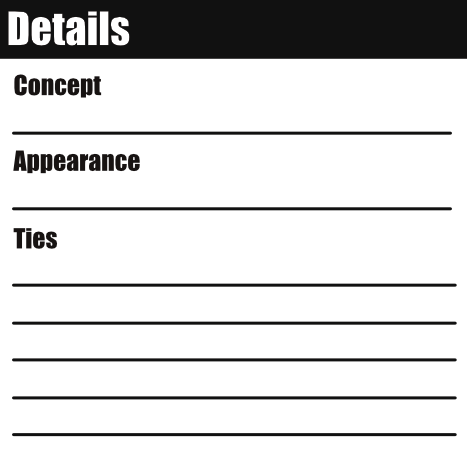
Concept
The concept of your character is like the elevator-pitch version of who they are.
On your character sheet, write a small sentence that quickly sums them up.
A good concept could include things like:
- their profession or role within the group
- where they come from
- a personality trait
- a unique talent they possess etc.
Appearance
Next is your character’s appearance.
Use this section to describe what your character looks like. You can talk about their shape, size, what they wear, etc.
This will help everyone at the table when they need to picture your character as they are interacting with them.
Ties
Since your character is one of the story’s protagonists, they need to be linked to the different forces in the world. They weren’t born yesterday (or were they?), so they have probably made friends or foes with different people or organizations.
To establish those links, we define ties.
A tie links your character to another player’s character, an organization, or other world forces.
When you write down a tie for your character, try to answer who is my character linked to and also how they are linked to them.
This will also help establish a bit of a general backstory for your character, without you having to write down 10 pages of notes that might end up staying unused.
Choosing Details in Play
You don’t need to entirely flesh out your character before you start playing.
Simply choosing your concept is more than enough to get going.
After the first session or two, you will have a better idea of who your character is, so finding those details later is totally fine.
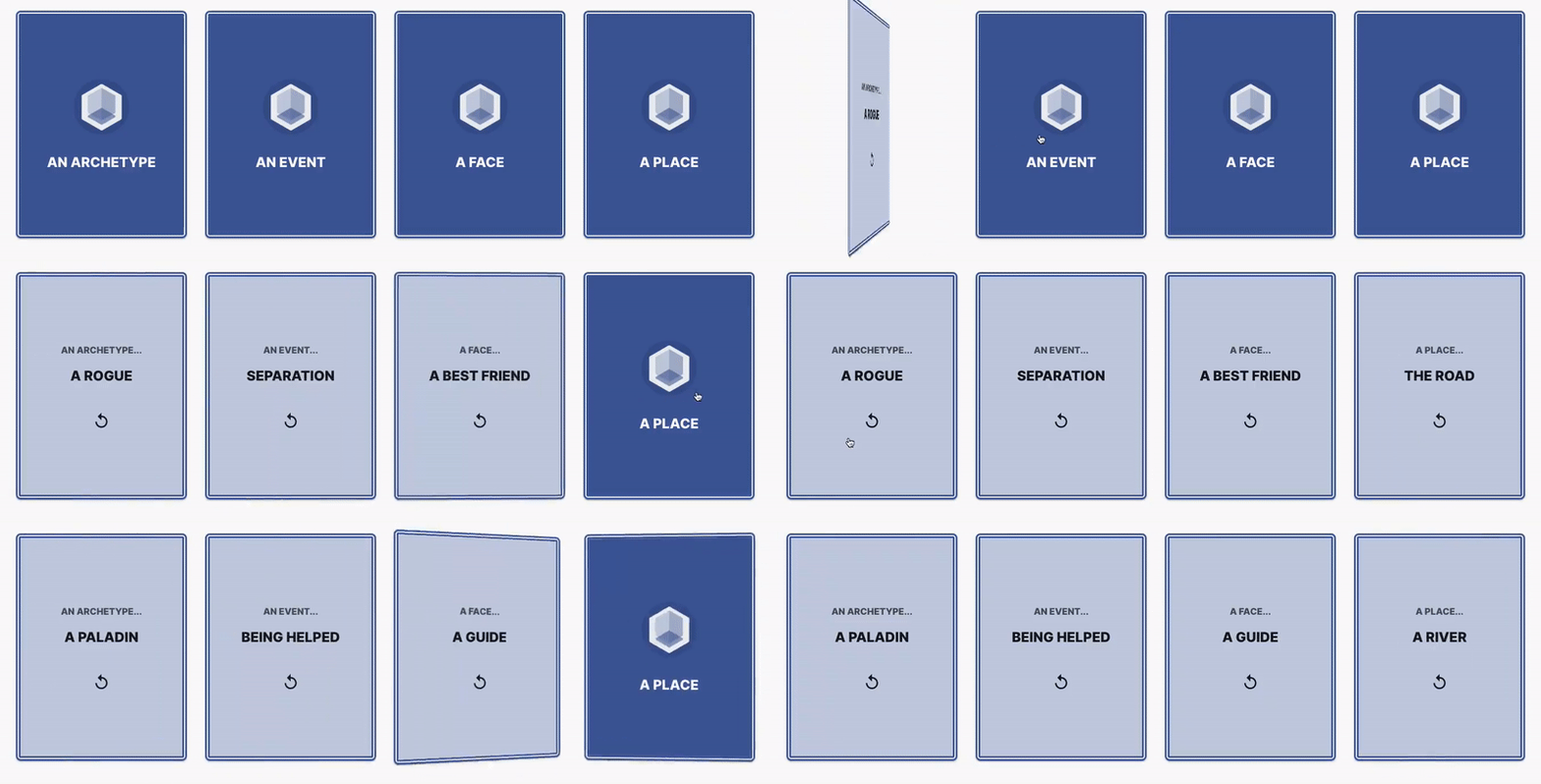
But if you want some help in fleshing out your characters, you can always use the free Fari Story Builder to get the inspiration flowing!
Actions
If a player character wants to do something challenging or that could potentially fail, they make an action roll.
Failure is possible if there is some sort of obstacle to overcome, like something that’s in your way or somebody looking to stop you.
That being said, not every interaction with the world requires a roll. If the character does something we’d expect them to simply accomplish, then you don’t roll anything. They simply do it.
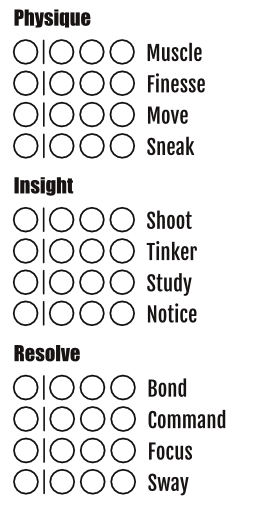
In Charge, there are 12 actions characters can do.
When creating a character, you need to distribute 7 action dots among those 12 actions. At the start of a campaign, a single action cannot have more than 2 action dots.
Those dots represent how good your character is at doing things. As the game progresses, you will gain additional dots that make your character more flexible. See Mechanics » Progression.
The 12 actions are grouped into 3 categories called Attributes. There is Physique, Insight and Resolve. For now let’s look at the 12 different types of actions.
The 12 Actions
Physique
When you Muscle, you use your force to move, overcome or wreck the obstacle in front of you.
You might lift, punch, grapple, hack and slash. You might wrestle with a wild animal. You might blast a door open. You could try to fight in a formal duel (but Finesse might be better).
When you Finesse, you employ dexterous manipulation or subtle misdirection.
You might steal something from someone’s pocket. You might hack a security system. You might helm the controls of a ship. You could try to pick a lock (but Tinker might be better).
When you Move, you quickly shift to a new position or get out of danger.
You might climb, swim, run, or jump. You might outpace the guards. You might jump above a spiked pit. You could try to lose someone on your tail (but Sneak might be better).
When you Sneak, you traverse skillfully and quietly.
You might sneak past a guard or hide in the shadows. You could try to back-stab a solder in the middle of a battle (but Muscle might be better).
Insight
When you Shoot, you carefully track and shoot at a target.
You might snipe an enemy long-distance. You might throw a fireball to light the battlefield on fire. You might aim the ship’s laser guns. You could try to skill-fully throw a dart in a bar game (but Finesse might be better).
When you Tinker, you understand, create, or repair complex mechanisms or organisms.
You might create a new gadget or alter an existing item. You might mend a broken bone. You could try to use your technical expertise to control a vehicle (but Finesse might be better).
When you Study, you scrutinize details and interpret evidence.
You might gather information from documents, newspapers, and books. You might closely analyze a person to detect lies or true feelings. You could try to examine events to understand a pressing situation (but Notice might be better).
When you Notice, you observe the situation and anticipate outcomes.
You might pick up important details in the moment. You might anticipate danger before it happens. You could try to figure out what is making someone sick (but Study might be better).
Resolve
When you Bond, you reassure and socialize with friends and contacts.
You might gain access to resources, information, people, or places. You might make a good impression or win someone over with your charm, style, or empathy. You could try to manipulate your friends with social pressure (but Sway might be better).
When you Command, you compel swift obedience with skills and respect.
You might intimidate or threaten to get what you want. You might ask a small militia to get their things together. You might order your undead minions to sacrifice themselves for you. You could also ask your familiar to look for something in a room (but Bond might be better).
When you Focus, you concentrate to accomplish a task that requires great strength of mind.
You might meditate to enter the spirit world. You might concentrate to win a game of chess. You might enter a trance to finish up an important ritual. You could try to pay closer attention to your surroundings beyond what is visible (but Notice might be better).
When you Sway, you influence with guile, charm, or argument.
You might lie convincingly. You might persuade someone to do what you want. You might argue a compelling case that leaves no clear rebuttal. You could try to trick people into affection or obedience (but Bond or Command might be better).
Which Action to Pick for a Roll
Some actions may overlap with others. This is by design. As your campaign progress, you group will also establish which action is the most effective in given situations.
Make this game your own.
As a player, you get to choose which action you roll by simply saying what your character does. Choosing one approach versus another might influence the risk or effect of your action. The GM should tell you those details before you roll.
Momentum
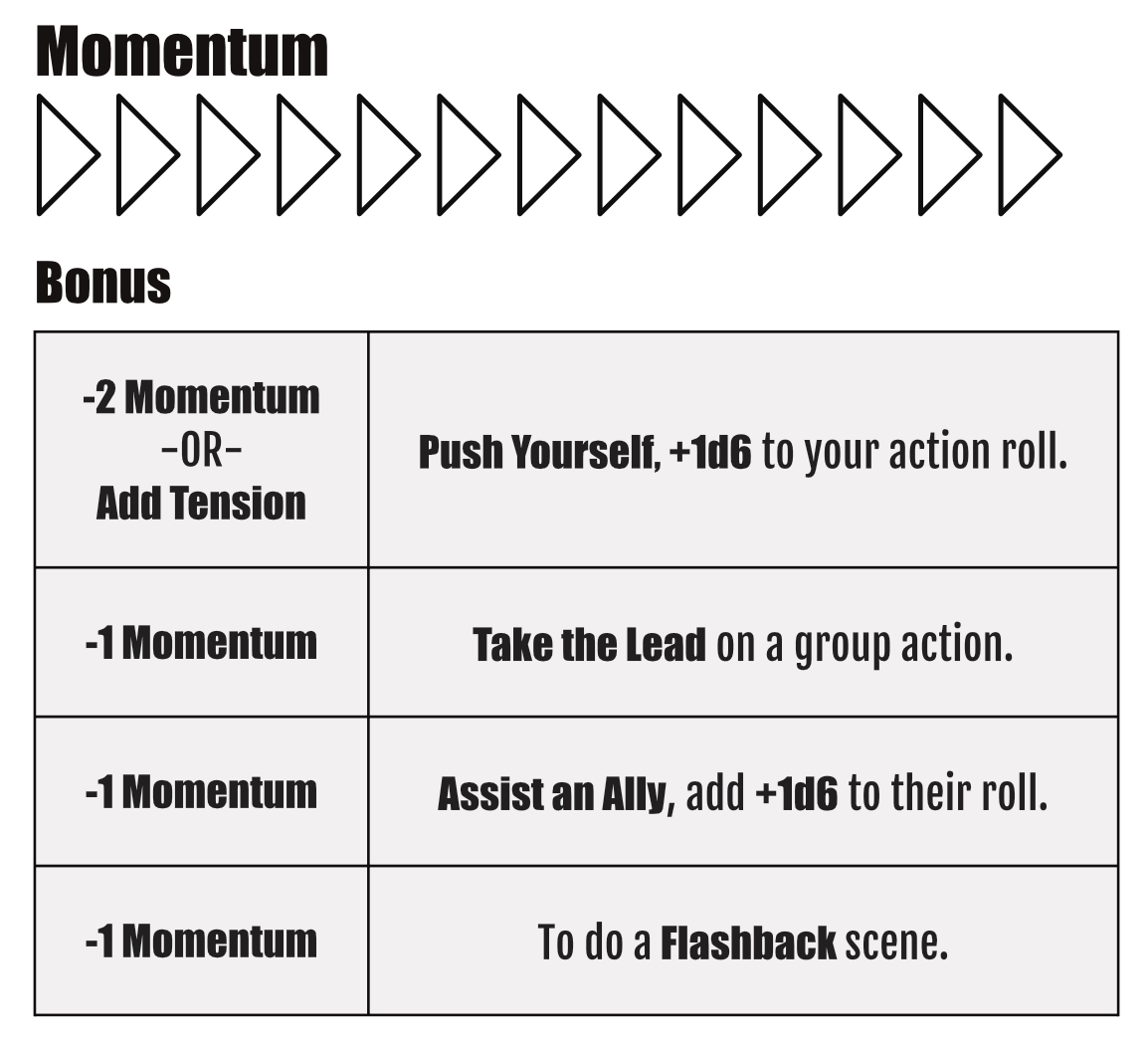
A character’s momentum is a measure that represents the impact of your character on the world. The more you interact with the world, and the people that live in it, the more your character gains charges of momentum.
You start with 2 momentum at the beginning of each session and consume it to boost your action rolls or assist your teammates.
Stress & Condition
When your character faces dangerous challenges and fails their action roll, something bad happens.
Maybe the situation is more complicated or even perilous. The alternative to this is that you get hurt. The GM is the one who decides if the consequence of the roll is harm or something else.
When you get hurt, you take a certain amount of stress, and each stress ticks a segment on your character’s stress clock.
Each time your character takes stress, you need to update your character’s condition and write down a short detail describing the state your character is in.
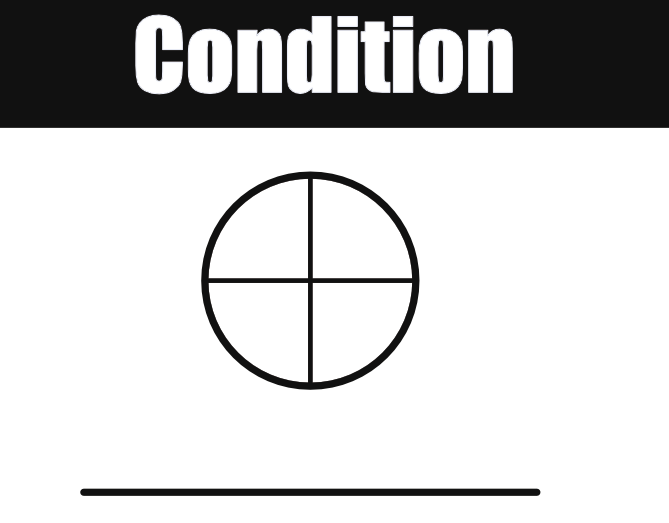
A Word on Clocks
Clocks are circles divided in 4, 6 or 8 segments used to track things that evolve over time during the game.
They are used to track a character’s condition, the different projects they are working on, the complications that they are creating around them, and even the obstacles that they are facing.
Clocks will be covered later in Mechanics » Clocks
When a character has a condition, their narrative liberties are restricted by said condition.
For example, it’s almost impossible to climb on the roof of a house with a twisted ankle. So even if you have only 2 segments ticked on your stress clock, your condition in and of itself still imposes narrative restrictions on what your character can do.
Here are a couple examples of conditions:
- When your stress clock has 1 or 2 segments filled, you might be: exhausted, humiliated, tired, sore, winded, sick, etc.
- When your stress clock has 3 segments filled, you might have a gunshot wound, a slash from a blade, a first degree burn, or be completely drunk.
- When your stress clock reaches 4 filled segments, you clear it, and are taken out for the scene. You might have gotten a second degree burn, or a fractured leg, or your brain can’t comprehend what is happening anymore.
Talents
Talents are a way to make the characters progress over the course of a campaign.
Over time, characters gain new talent dots which make their talent tree advance.
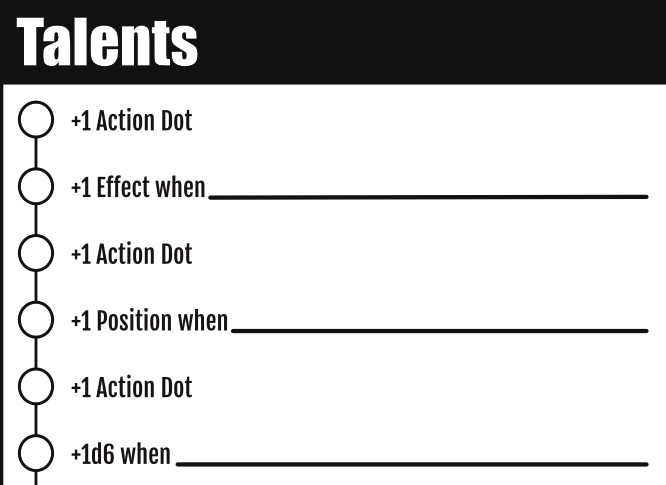
Every dot in the talent tree gives you either a new action dot, or a situational bonus.
A situational bonus often represents a boost in effect, an increased dice pool or a reduction of the risk, but it only triggers in a certain situation.
You don’t need to worry about talents right now, especially if you just started your campaign.
When your campaign reaches a significant turning point, you can read Mechanics » Progression to know how to make the characters feel more flexible.
Projects and Complications
The Projects and Complications section of the character sheet is something the GM and players use to track long-term projects or ever-evolving dangers that span multiple sessions.

You don’t need to know how to use this right away, so for more on this, check out Mechanics » Projects and Complications.
Character Recap
That covers the basic of how to create a character for Charge.
Now we will go over all the mechanics used in the game that exist to resolve unknown elements in the narrative.
The Character Sheet
- Character details to highlight who they are. (Concept, Appearance, and Ties)
- 7 Action dots distributed across the 12 actions to explain what they are good at.
- Momentum charges to boost your actions and help your teammates.
- A stress clock and condition to represent the physical and mental state of a character.
- A talent line to make the character feel more powerful.
- Projects and complications clocks to track session-spanning efforts or dangers.
Fiction First

Charge is a “fiction first” game.
This means that the GM and the players tell a story, and afterwards look at the rules to see if something needs to be resolved using the game’s mechanics.
You can see the mechanics in Charge as tools in a box, to use as needed. They resolve situations where you don’t know the direct answers to a question.
Will this character find what they are looking for? Can that character convince this merchant to talk? How will this faction react to this big event? etc.
Sometimes, those situations are resolved with a mechanic that relies on the PCs’ proficiencies, while other times they might be resolved with mechanics that straight-up relies on luck!
We do this to create a “wow” feeling in unknown situations. While the story is created by everyone at the table, the mechanics act as a guide that drives the narrative forward with unexpected outcomes.
Those mechanics mostly rely on figuring out what the risks are, and what is happening. Then a set of six-sided dice is rolled, results are interpreted, and the story moves on.
Rolling Dice
The game uses six-sided dice. You roll several at once, which we call a dice pool, and read the single highest result.
- If the highest die is a 6, it’s a full success. Things go well. If you roll more than one 6, it’s a critical success and you gain some additional advantage.
- If the highest die is a 4 or 5, that’s a partial success. You do what you were trying to do, but there is a consequence.
- If the highest die is 1-3, it’s a bad outcome. Things go poorly. You don’t achieve your goal, and suffer a consequence.
If you ever need to roll but you have zero (or negative) dice, roll two dice and take the single lowest result. You can’t roll a critical when you have zero dice.
Most of the game’s mechanics revolve around this basic format.
Action Roll

I have a bad feeling about this…
You want to accomplish a goal, but something or someone is in your way. A person might be keeping information private that you desperately need, a locked door might block you from moving forward to save your friend, or a group of thugs intercepts you in an alley and wants revenge for something you’ve done to them in the past.
That’s a challenge that needs to be overcome.
To see how it turns out, we make an action roll by going through the following steps:
1. Player Sets Their Goal
The first step in knowing whether or not your character overcomes the challenge is to know what they are doing and what is their goal.
Once the goal of your character has been established, the player decides which one of the 12 actions they are going to use. Are they Bonding with a local merchant, or Swaying them into thinking that their prices are too high?
The action rating is used to define the initial dice pool of the roll.
Active Opposition
In Charge, NPCs don’t roll for their actions. NPCs automatically succeed at their actions unless players attempt to intervene. In this case, an action roll does double-duty: it resolves the action of the PC as well as any NPCs that are involved. This encourages players to get involved in the action and be proactive, rather than to sit back and be a passive participant.
The action roll tells us the results, and the consequences of an action at the same time.
On a 6, the PC wins and gets what they wanted. On a 4 or 5, both the PC and the NPC have an effect on the result. On a 1-3, the NPC wins and the outcome results in a consequence for the PC.
2. GM Sets the Risk
The GM sets the risk of the action based on what has been established in the narrative.
The risk is either, low, moderate or high.
- When the risk is low, things are under control. Even if things go wrong, there is a way out.
- When the risk is moderate, the situation is dangerous. If you fail, there will be repercussions.
- When the risk is high, the odds are against you. Attempting to go against them might backfire heavily.
By default, an action roll has a moderate risk. You wouldn’t be rolling if there was no risk involved.
The GM uses the narrative context to determine which risk to pick.
The action being used is another thing that might affect the risk of a roll — you are trying to convince a merchant who’s in a bad mood, using Sway might be pretty high risk. Bond on the other hand could put you in a more low risk position, considering the situation.
The risk helps determine what failure looks like.
3. GM Sets the Effect Rating
The risk isn’t the only thing that helps resolve the end result of a roll. Even in a high risk situation, succeeding on a roll might still have a great effect on the narrative.
In Charge, there are 3 possible effect ratings: great, standard, and limited. In most common scenarios, if you are rolling to overcome something, you are probably looking at generating a standard effect. The GM is responsible for telling you this information.
If a heavy door is blocking your way, you could use Finesse to pick the lock. This might generate a standard effect, since it will take some time to do, but the roll would be low risk. You could also try to use Tinker and wreck the door open with an explosive. This may create a great effect, but might be a high risk situation as it could create a lot of unwanted attention.
The effect rating helps determine what success looks like.
The Fourth Effect Rating
We said there were only 3 effect ratings, and that was actually a little bit of a lie since there’s a fourth one called the no-effect.
The GM can use this when a task is so difficult that whatever the PC attempts, there is no chance of success.
Obviously, doing nothing is boring. That’s why you can boost that no-effect to a limited effect if you Push Yourself using charges of momentum. More on that in Even the Odds.
The Impact of Effect & Risk
The effect and risk help us understand what happens in the narrative, but they also have a mechanical impact on the game.
To know what impact they have, numerical ratings are attached to them.
Risk Effect Rating High Great 3 Moderate Standard 2 Low Limited 1 When a roll succeeds, you use the effect rating to see how many segments you tick on progress clocks, how much information the character gets out of an investigation, etc.
When a roll creates a consequence, you use the risk rating to see how many segments you tick on danger clocks, how much stress a character gets when they are harmed, etc.
While the GM usually sets the initial ratings, the entire table should participate in the discussion to make sure all aspects of the fiction are taken into consideration before an action roll is made.
More on clocks in Mechanics » Clocks
4. Player Evens the Odds
Even if the odds are stacked against them, your character still has aces up their sleeves.
The player can decide if they want to even the odds by adding bonus dice to their pool.
You can normally get two bonus dice for your action roll.
For one bonus die, you can get assistance from a teammate. They consume 1 momentum, say how they help you, and give you an extra 1d6.
For another bonus die, you can use one of the following methods
Push Yourself
When you push yourself, you consume 2 momentum per push to gain one of the following bonuses.
- Add an extra 1d6 to your dice pool.
- Increase the effect of your roll.
- Take action even if you were taken out.
Add Tension
When you add tension to an action roll, you can ask the GM “What would adding tension look like here?”. The GM then offers a consequence, like ticking segments on a danger clock, inflicting stress on your character, or adding more drama to the narrative.
If you accept the consequence, add an extra 1d6 to your current dice pool.
There could be scenarios where adding tension isn’t an option. In that case, the GM can simply communicate that to the player so that they look into other ways to even the odds.
Assist
When you assist a PC, you consume 1 momentum, to give an extra 1d6 to their roll. When doing this, you also expose yourself to possible danger.
Use an Asset
Assets are an optional rule available in Extras » Asset Extra, which gives an additional way to even the odds.
Recap
So now, let’s go over all of this again to recap what happens when you make an action roll.
Action Roll
- Pick an Action and find out how many dice you need to roll (the action rating)
- Determine the risk (1 low ► 2 moderate ► 3 high)
- Determine the effect rating (3 great ► 2 standard ► 1 limited)
- Add 1d6 if: you push yourself (2 momentum) -or- if you add tension to the scene.
- Add 1d6 if you have assistance (they consume 1 momentum)
- Roll and wish for the best!
——
- On a 66 critical success, you greatly overcome the obstacle
- On a 6 full success, you overcome the obstacle.
- On a 4-5 partial success, you overcome the obstacle, but there’s a consequence.
- On a 1-3 bad outcome, you fail at overcoming the obstacle, and there’s a consequence.
Example
Xavier’s character wants to take out a guard without him noticing anything. He decides to use Sneak. The GM looks at the situation and assesses that it is of moderate risk since the guard might not be alone, but the outcome would be of great effect because the guard isn’t on high alert. Xavier doesn’t want to leave everything up to chance, and decides to even the odds. He declares that his character will push themselves to get an additional 1d6 by diving in the water to get closer before taking the guard out. Xavier rolls his dice pool and… gets a 5, partial success! The GM then says that Xavier’s character takes out the guard, but ticks 2 segments on an “Alert Clock” because of the noise Xavier’s character made pulling the guard in the water.
Consequences

Sometimes things work out. Other times…
If you make an action roll and you get a partial success (4-5) or a bad outcome (1-3), you suffer a consequence.
Consequences are a tool the GM can use to spice up the story. The GM uses the fiction, style, and tone established by the group to determine the type of consequence.
Consequence Rating
When a consequence is inflicted on a player’s character, the risk of the action roll tells us how bad that consequence is.
So a consequence that comes from a high risk action roll is usually worse than a consequence from a low risk one.
We call this the consequence rating. Some types of consequences use this rating directly to tie the consequence with some of the game’s mechanics.
| Risk | Consequence Rating |
|---|---|
| High Risk | 3 |
| Moderate Risk | 2 |
| Low Risk | 1 |
Types of Consequences
Here are a couple of types of consequences that can be used in case of a bad roll:
Reduced Effect
This consequence represents impaired performance. The PC’s action isn’t as effective as they’d anticipated.
Reduces the effect rating of the PC’s action by one level.
——
You hit them, but it’s only a flesh wound. The security cameras are turned off, but the technicians are aware, and are looking to fix them as soon as possible.
Complications
This consequence represents trouble, mounting danger, or a new threat.
Tick one segment per consequence rating on a new or existing danger clock.
——
They heard you, and they are coming. You took too long, and you are almost out of air.
Lost Opportunity
This represents shifting circumstance. What you tried didn’t work, and now there’s a new situation that prevents you from trying again. You need to find another approach.
Your latest attempt didn’t work. If you want to try again, you need to use a different action.
——
You were tailing someone, but they saw you and disappeared. You were fighting a robot, but they adapted, and are now able to anticipate your every move.
Escalated Risk
This consequence represents losing control of the situation. The action carries you into a riskier situation.
Perhaps you make the leap across to the next rooftop, only to end up dangling by your fingertips. You haven’t failed, but you haven’t succeeded either. You can try again, re-rolling at the new higher risk.
This is a good consequence to choose to show escalating action. A situation might go from controlled, to risky, to desperate as the action plays out and the PC gets deeper and deeper into trouble.
Increases the risk by one level for future rolls related to that action.
——
You missed your shot, now they know where you are. They initially trusted you, but now they have some doubts and will be watching you more closely.
Worse Condition
This consequence represent injuries or trauma inflicted on a character.
When your condition worsens, you take a certain amount of stress that you track on your character’s stress clock. You also need to update your condition to represent the new state your character is in.
Your character’s new condition will affect their narrative permissions, and how they can interact with the world.
When your stress clock is filled, you can clear all the segments, and your character is taken out for the scene.
Take 1 Stress per consequence rating on your character’s condition.
——
You laid down suppression fire, but got shot in the process. You’ve been running for hours to get to the place but now, you’re sore and tired.
Negating Success
Don’t inflict a complication that negates a successful roll.
If a PC tries to corner an enemy and gets a 4-5, don’t say that the enemy escapes. The player’s roll succeeded, so the enemy is cornered… maybe the PC has to wrestle them on the ground, and during the scuffle the enemy grabs their gun.
I Have an Idea for a Consequence!
If anyone at the table has an idea for a good consequence, hear them out!
It can be daunting as a GM to always know what happens in case of failure. That is true especially if luck isn’t on the player’s side, and you need to find lots of different consequences in the same session.
As the GM, don’t hesitate to ask your players for ideas as well. Someone might have a fascinating suggestion, but they think it’s not their place to speak up. Prove to them otherwise.
Safety Reminder
Just a quick reminder that if you come up with a consequence during a session, and someone at the table isn’t comfortable with it, think of something else.
Pause the game, and make sure everyone is OK with what is happening in the fiction. Once everyone is on the same page, unpause and move forward with a different consequence.
Even with safety mechanics in place, accidents happen. That is why you should always be flexible when you inflict a consequence to the group.
Recap
Consequences
If the result of an action roll is between 1-5, the GM inflicts one consequence:
- Reduced Effect : reduce the effect of the action by one level.
- Complication: tick one segment per consequence rating on a new or existing danger clock.
- Worse position: increase the risk of future related action rolls by one level.
- Lost Opportunity : what you tried didn’t work, you need to use another action.
- Worse Condition: take 1 stress per consequence rating.
Determination Roll
Not on my watch! (you are filled with determination)
If a character suffers a consequence that you, as a player, don’t like, you can try to resist it.
You do so by calling for a determination roll to see how well you resist the consequence.
You make that roll by burning momentum. Build a pool of d6s by adding 1d6 per charge of momentum.
Once you’ve decided how many charges you want to consume, roll and interpret the results:
- On a 1-3, the consequence still happens.
- On a 4-5, the consequence is reduced.
- On a 6, the consequence is avoided.
- On a 66, the consequence is avoided, and the risk of your next roll is lowered.
If you want, you can also resist a consequence that isn’t targeting you directly. If you want to do so, see Team Work » Protect.
Recap
Determination Roll
- Roll a pool of d6s by adding 1d6 for each charge of momentum you are willing to consume for the roll.
- On a 1-3, the consequence still happens.
- On a 4-5, the consequence is reduced.
- On a 6, the consequence is avoided.
- On a 66, the consequence is avoided, and the risk of your next roll is lowered.
Flashbacks
The rules don’t distinguish between actions performed in the present moment and those performed in the past. When a scene is ongoing, you can invoke a flashback to roll for an action in the past that impacts your current situation. Maybe you went to a bar last night and befriended a couple of guards to make them drunk so that they call sick the next day. You then do a flashback scene, and make a Bond roll to see how that went.
The GM sets a cost in momentum for you to activate the flashback.
- 0 momentum: An ordinary action for which you had easy opportunity.
- 1 momentum: A complex action or unlikely opportunity.
- 2 (or more) momentum: An elaborate action that involved special opportunities or contingencies.
After the momentum is consumed, a flashback action is handled just like any other action. Sometimes it will entail an action roll, because there’s some danger or trouble involved.
Sometimes a flashback will entail a fortune roll, because we just need to find out how well (or how much, or how long, etc.). Sometimes a flashback won’t call for a roll at all and just consuming the momentum will be enough.
When you are using flashbacks, you are focusing on the problems that do happen, not the problems that might happen.
Limits of flashbacks
A flashback isn’t time travel. It can’t “undo” something that just occurred in the present moment. If the GM described something in the scene, it is now established in the fiction.
While you can’t undo what has already happened, you can twist and adapt things that were left unsaid.
For instance, if a maître d’ is making a scene to stop you from entering at a very high end restaurant, that’s perhaps because you Swayed them into doing this the night before in exchange for money to make a diversion for the rest of the group.
Recap
Flashback
Use this to handle the unpredictable.
- GM sets a cost in momentum (0-2) for you to do a flashback scene.
- Depending on the fiction, either
- the player gets what they want.
- the GM makes a fortune roll to see what happens.
- the player makes an action roll to see what happens.
Momentum
We’ve talked about the fact that characters have a momentum track, which starts with 2 charges at the beginning of every session.
We’ve also seen that momentum can be consumed to boost action rolls, assist allies, and do flashback scenes.
Now we will go over the different methods to gain momentum during scenes.
Basically, you can either gain momentum as a result of an action roll, or by adding tension to the scene.
Momentum from an Action
Everytime you make an action roll, you have a chance of gaining new charges of momentum.
The reason why each character starts with only 2 momentum at the beginning of a session is because we want players who are running low to engage with the game mechanics instead of sitting back because they are out of resources.
The main way you get momentum back is by participating in the game.
By default, you gain momentum as a result of a successful action roll.
- If you rolled a 4-5, you gain 1 momentum.
- If you rolled a 6, you gain 2 momentum.
- If you rolled a 66, you gain 3 momentum.
Also, when momentum is spent for a roll, that roll cannot in turn generate momentum.
While this is the default dial, we encourage you and your group to change this as you wish. Making momentum harder or easier to gain will have a big impact on the way the game plays out.
Momentum Dial
Changing when and how much momentum is gained is called a momentum dial. Your group could decide to use the default setting for this dial, as it is a good starting point, but they could also change it more to their liking.
If for example you want to emphasize the fact that life is hard and resources are scarce, then consider making momentum harder to gain. If on the other hand, you want to tell the story of characters who are over-the-top, but still find a way to finish every adventure with their hat still sitting on their head, then consider making momentum easier to gain.
Recap
Momentum
- Every time you make an action roll, you have a chance to gain momentum.
- You start every session with 2 momentum.
——
When momentum is spent for a roll, that roll cannot in turn generate momentum.
——
Default Momentum Dial
- Gain 1 momentum for a 4-5.
- Gain 2 momentum for a 6.
- Gain 3 momentum for a 66.
Recovery

Now, breathe…
As the game plays out, the PCs will get more stressed out and their condition will worsen.
When a PC accumulates stress, their actions are limited because of the narrative restrictions their condition creates.
Not every action will go well, and failing an action has consequences, which in turn will affect the characters for some time. The stress clock is used to track exactly this.
Things will eventually go back to normal, and the PCs will recover. But for the recovery to happen, it needs to happen in the fiction first.
Recovering in the Fiction
When a player wants their character to recover stress, there needs to be downtime in the fiction.
If the group spends 3 sessions battling monsters in an epic dungeon, and tension is always through the roof, then the fiction doesn’t allow for the recovery process to begin.
That being said, downtime doesn’t mean that all the PCs have to sit down by a campfire and talk until they are all at “full health”.
In Charge, the structure of a session isn’t enforced, so the PCs can do what ever they want, whenever they want. This is why there will be moments when it just doesn’t make sense for the PC to recover at that time.
So the only way to recover from stress is in-fiction. You can either rest, lay low or seek medical attention. When doing so, the GM will look at the fiction and tell you how much stress (1-4) you clear on your stress clock.
As your character gets better, you also need to update your condition to represent your character’s current state.
We aren’t using dice to support this mechanic because we don’t believe luck should generally factor in the healing process. Of course, there are moments where it could. If you want, you can use the Fortune Roll mechanic to resolve this type of situation.
Recap
Recovery
Use this to heal and recuperate.
- When resting, laying low or seeking medical attention, clear between 1-4 segments from your stress clock and update your condition.
Fortune Roll

The future is in constant flux.
The fortune roll is a tool that the GM can use to disclaim decision making in a situation the PCs aren’t directly involved in. It can also be used by the players when no other roll applies to the situation at hand. The result of the roll helps guide the outcome as to where the story goes next, but doesn’t feature momentum nor consequences.
You are looking in the wreckage of a ship; is anybody left alive? You find a pistol on the ground; are there still bullets in it? Two factions are at war; who will win the final battle?
To make a fortune roll, build a dice pool by using a specific action or by adding 1d6 per likeliness level of a thing happening.
- If there’s a 50% chance of success, roll 1d6. If it’s more than that, add more dice to the pool.
- If it’s really unlikely, roll 2d6 and pick the lowest result.
If two forces are opposing one another, roll two opposing pools and take the best result of each to interpret who “won” and by how much.
Once the pool(s) are ready, throw the dice and interpret the results.
- On a 66, it’s a critical success. There are great results, and something exceptional happens.
- On a 6, it’s a full success. There are great results.
- On a 4-5, it’s a partial success. There are mixed results.
- On a 1-3, it’s a bad outcome. There are bad results.
There’s someone left alive on the ship, and they are still breathing. There are bullets in the gun, but the gun itself is broken and can’t be used.
Don’t overthink this as this rule should not get in the way of the game. This mechanic is there to quickly spice things up during a scene when there’s an unknown element and we want to see how it plays out.
Recap
Fortune Roll
- Build a dice pool by using a specific action or by adding 1d6 per likeliness level of a thing happening, roll, and interpret the results.
- If it’s really unlikely, roll 2d6 and take the lowest result.
——
- On a 66, it’s a critical success. There are great results, and something exceptional happens.
- On a 6, it’s a full success. There are great results.
- On a 4-5, it’s a partial success. There are mixed results.
- On a 1-3, it’s a bad outcome. There are bad results.
Team Work

It’s dangerous to go alone, take this!
There are multiple ways player characters can help each other in Charge. They could assist each other, make a setup action, or even protect someone from danger.
Assist
When you assist, you help another player who’s making an action roll. Describe what your character does to help. When doing this, you also expose yourself to possible danger.
Consume 1 momentum, and give them an additional 1d6 for their roll.
——
I can’t reach it, can you give me a boost?
Protect
You step in to confront a consequence that one of your teammates would otherwise face. Describe how you intervene.
You can make a determination roll to try to reduce or cancel the consequence.
You suffer the consequence instead of them. You may call for a determination roll to reduce or cancel the consequence.
——
Get behind my shield!
Set up
When you perform a setup action, you make an action roll to have an indirect effect on an obstacle. If your action has its intended result, any member of the team who follows through on your maneuver either gets an improved effect or a reduced risk for their roll.
You choose the benefit, based on the nature of your setup action.
Make an action roll to improve the effect rating or reduce the risk of a future action roll.
——
First I’ll distract them. Then you gotta make a run for it. OK?
This is a good way to contribute to an operation when you don’t have a good rating in the action at hand. A clever setup action lets you help the team indirectly - either in the moment or via a flashback. Multiple follow-up actions may take advantage of your setup as long as it makes sense in the fiction.
From Zero to Limited
Since a setup action can increase the effect of follow-up actions, it’s also useful when the team is facing very tough opposition.
Even if the PCs are reduced to zero effect due to disadvantages in a situation, the setup action provides a bonus that allows for limited effect.
This gives them a fighting chance.
Clocks
A clock is a circle divided into 4, 6, or 8 segments. Draw a clock when you need to track an ongoing effort against an obstacle that cannot be resolved with a simple action roll.
Sneaking into a restricted area? Make a clock to track the alert level of the patrolling guards. When the PCs suffer consequences from partial successes or missed rolls, fill in segments on the clock until the alarm is raised.
Generally, the more complex the problem, the more segments the clock should have.
A complex obstacle is a 4-segment clock. A more complicated obstacle is a 6-segment clock. A daunting obstacle is an 8-segment clock.
Segments of clocks are ticked after an action roll. The effect and risk ratings help decide how many segments should get ticked as a result of the roll.
Clocks should always be about the obstacle that needs to be overcome, and not be about the “how”. The action of the character already takes care of explaining the “how”.
Here are a couple examples of how clocks could be used to represent some situation that might arise during scenes.
Progress Clocks
These represent the ongoing effort of someone to achieve their goal.
When a PC succeeds an action roll, you can use a progress clock and:
- Tick 1 segment for a limited effect.
- Tick 2 segments for a standard effect.
- Tick 3 segments for a great effect.
——
How much money do we need before we can fix the ship? How much damage can the city withstand before there’s nothing left to save?
Danger Clocks
These represent the imminent danger about to face the player.
When a PC gets a consequence from an action roll, you can use danger clock and:
- Tick 3 segments for a high risk action.
- Tick 2 segments for a moderate risk action.
- Tick 1 segment for a low risk action.
——
How long until they realize we are here? How much oxygen do we have left?
Opposing Clocks
These represent the progress of two opposing parties to get to their goal. The effect and risk ratings can both be used to tick one or the other clock.
——
Can we win the race against the fan favourite? Can we convince the judge that we are wrongly accused before the end of the trial?
Recap
Clocks
Used to define complex obstacles.
- GM creates a clock to represent long-lasting obstacles.
- Divide into 4 segments for a complex obstacle.
- Divide into 6 segments for a complicated obstacle.
- Divide into 8 segments for a daunting obstacle.
——
When a PC succeeds an action roll, you can use a progress clock and:
- Tick 1 segment for a limited effect.
- Tick 2 segments for a standard effect.
- Tick 3 segments for a great effect.
When a PC gets a consequence from an action roll, you can use danger clock and:
- Tick 3 segments for a high risk action.
- Tick 2 segments for a moderate risk action.
- Tick 1 segment for a low risk action.
Progression

That’s something I’ll never forget.
Even at the start of the story, characters in Charge are talented and proactive.
After all, they are the protagonists of our story. If they fail at a task, it’s probably more because of unplanned circumstances than because of their lack of skills.
As time advances, the characters evolve and become more versatile, but this will only happen at certain milestones.
Sessions
At the end of each session, each player can look at their character sheet and update their character’s details.
You can use this opportunity to update their ties, appearance or even their concept if something important happened in the last session.
This is optional, but you can view this as an opportunity to update who your character is after each session and how they evolve over time.
Milestone
A milestone happens at the end of a big event in the story. This will usually happen every 3-5 sessions. Players invest those milestones in their respective talent tree to make their characters stronger and more versatile.
A talent either gives a new action dot to invest in a character’s actions, or a new situational talent which gives a temporary boost to their character in specific circumstances.
When a player gets a situational talent, they need to decide on a specific situation that activates the talent. The player chooses what they think works best for their character and note their decisions by filling in the blanks on their character sheet. For inspiration look at what has already been established in the world, and pick something that makes your character shine.
The GM will probably feel when it’s time for a milestone, but as a player you can always remind the GM “Hey, this looked like an important event in the story, would this be a milestone?”.
Just go with what feels right and adapt if necessary.
Gaining a new talent will feel like a breath of fresh air. It won’t make your characters overpowered or god-like, but it will make them more flexible, or more specialized.
Progression Curve
Just as a reminder, the longer it takes for a milestone to happen, the longer it will take for characters to become stronger.
This is important to keep in mind depending on what kind of progression curve you want to have.
Do you want to have a short campaign where characters will grow stronger pretty quickly, or are you looking for a year-spanning campaign where the characters will mostly evolve by changing their character details and where milestones will be more scarce?
You could go as low as giving the player character only 2-3 Talents during an entire campaign, or reward them more often.
There isn’t a right or wrong answer here. It depends 100% on what kind of campaign you want to have. This is also something you can discuss with the group to make sure everyone has the same expectations.
Starting Talent
Some groups already have a pretty good idea of who their character is and what they are good at.
If that is the case with your group, it might be a good idea to offer them a starting talent in the form of +1 Effect when.
This will give them an edge in certain situation, without breaking the balance of the game.
There’s an adapted character sheet to get you started.
Situational Talents
Certain talents are situational. That is, they are only activated when you are in a certain context and using a specific action.
For example, when you get a 1 Effect when, you will need to finish the end of that sentence by choosing one of the 12 Actions and a certain Situation that will activate the talent.
Just look at what as already been established in the world, or your character’s details, for inspiration.
To keep the flow of the game balanced, the GM will have a veto on what situation is good enough for your talent. Don’t hesitate to experiment with this and fine-tune later if necessary.
The fact that writing up situational talents takes a bit of work is the reason why you don’t get any talent dot by default at character creation.
We want character creation to be as streamlined as possible. Take the time to understand and discover who your character is first.
Later in the campaign, when a milestone occurs, then you can think of new ways to make them truly unique using talents.
Yann’s character is a monster hunter. Consequently, he’s pretty good at Studying and Muscle in general. Yann also just got a new talent dot and would like to excel at tracking monsters specifically. Because monsters aren’t encountered that frequently in the game, he asks the GM if his talent could be “Reduced Risk when I’m Shooting monsters”. The GM agrees. Now, Yann’s character should be feared by most creatures roaming the lands.
In another session, the GM realizes that Yann’s talent is perhaps too generic, and could be tuned a little. He then asks if it could be rewritten as something like “Recuded Risk when I’m Shooting monsters in the forest” or something along those lines. Yann agrees, saying “My character lived in the forest all their life, and would probably be intimidated by big cities. I like it; let’s go with this for now!”
Projects and Complications
The Charge character sheet has a Projects & Complications section which contains a set of empty clocks.
Those clocks represent long-term projects or ever-evolving danger that the character will work on or experience across multiple sessions.
Long-term Projects
Perhaps your character is piling up money to be able to afford something good for their family, or perhaps they are trying to figure out a way to reverse the damaged caused by a dangerous new disease that’s plaguing the city.
In any case, once per session, if the narrative allows it, a character can make an action roll to work on those long-term agendas. The player works with the GM to describe what action they are taking to advance their agenda and figure out the effect and risk of the roll.
These projects are tracked using progress clocks on the character sheet. The effect rating of the roll determines how much the project progresses when the character is working on it.
Upon the completion of a project, the PC gets what they were working for. The resolution of said project creates a new narrative thread explained by the GM. This thread is something the group can decide to pursue or not.
Complication
Perhaps the police department is starting to realize there are missing pieces in the evidence locker, or perhaps you are starting to attract more and more heat on you and your crew after your last couple jobs.
When a complication occurs as a result of a consequence of an action roll, the GM can tell the player to start or tick a danger clock on their character sheet.
Those complications aren’t bound to the scene. Instead, they are tied to the character or the group as a whole.
Upon the completion of a complication’s danger clock, the GM reveals a new dangerous situation to the group to represent what comes as a result of their actions.
Depending on the context, this new complication could be imposed or exposed to the group.
- When it is imposed, the characters need to resolve it as soon as possible. The story cannot continue without this being taken care of first.
- When it is exposed, the GM can foretell that the life of the group will be a bit more complicated because of a certain situation that comes from a result of that complication.
The goal here is to add emphasize that every action elicits a reaction from the world, even if it isn’t immediate.
In a Nutshell
This chapter will go over the most important bits of the book in a quick recap so that it’s easy to use as a reference.
Character Creation
Details
Define who your character is.
- Concept: The elevator pitch of your character.
- Appearance: What your character looks like.
- Ties: Connection with the other player’s character or forces within the world.
Actions
Distribute 7 action dots among the 12 actions to define how good your character is at doing things.
At character creation, a single action cannot have more than 2 action dots.
Physique
- When you Muscle, you use your force to move, overcome or wreck the obstacle in front of you.
- When you Finesse, you employ dexterous manipulation or subtle misdirection.
- When you Move, you quickly shift to a new position or get out of danger.
- When you Sneak, you traverse skillfully and quietly.
Insight
- When you Shoot, you carefully track and shoot at a target.
- When you Tinker, you understand, create, or repair complex mechanisms or organisms.
- When you Study, you scrutinize details and interpret evidence.
- When you Notice, you observe the situation and anticipate outcomes.
Resolve
- When you Bond, you reassure and socialize with friends and contacts.
- When you Command, you compel swift obedience with skills, respect or intimidation.
- When you Focus, you concentrate to accomplish a task that requires great strength of mind.
- When you Sway, you influence with guile, charm, or argument.
Momentum
- Every time you make an action roll, you have a chance to gain momentum.
- You start every session with 2 momentum.
When momentum is spent for a roll, that roll cannot in turn generate momentum.
Default Momentum Dial
- Gain 1 momentum for a 4-5.
- Gain 2 momentum for a 6.
- Gain 3 momentum for a 66.
Using Momentum
Cost Result 2 momentum Push yourself and add +1d6 to your action roll. 1 momentum Assist an ally, add +1d6 to their action roll. 0-2 momentum Do a flashback scene.
Stress
On a failed action roll, GM can inflict stress on a PC.
The number of stress inflicted depends on the action’s risk:
- Low Risk: 1 stress
- Moderate Risk: 2 stress
- High Risk: 3 stress
Each stress ticks a segment on a PC’s stress clock. When you mark stress, you also need to add/update your condition.
When the clock is filled, your character is taken out for the scene and your stress clock is cleared.
Projects and Complications
Use these clocks when a player has a long-term project or when the GM inflicts a complication as a consequence.
Doing Things
Action Roll
Use this when someone, or something, is in your way.
- Pick an action and find how many dice you need to roll.
- Determine the risk (1 low ► 2 moderate ► 3 high)
- Determine the effect rating (3 great ► 2 standard ► 1 limited)
- Choose one:
- Add +1d6 if you push yourself (2 momentum)
- Add +1d6 if you add tension to the action.
- Add +1d6 if you have assistance (they consume 1 momentum)
- Roll and wish for the best!
If you don’t have any action dots and can’t push yourself, add tension, or request assistance, roll 2d6 and take the lowest result.
Result Name Explanation 66 Critical Success You greatly overcome the obstacle. 6 Full Success You overcome the obstacle. 4-5 Partial Success You overcome the obstacle, but there’s a consequence. 1-3 Bad outcome You fail at overcoming the obstacle, and there’s a consequence. Determination Roll
Use this to resist a consequence, or incoming stress.
- Build a pool of d6s by adding 1d6 for each charge of momentum you are willing to consume for the roll.
- On a 1-3, The consequence still happens.
- On a 4-5, The consequence is reduced.
- On a 6, The consequence is avoided.
- On a 66, the consequence is avoided, and the risk of your next roll is lowered.
Recovery
Use this to heal and recuperate.
- When resting, laying low or seeking medical attention, clear between 1-4 segments from your stress clock and update your condition.
Team Work
Assist
Use this to help a fellow PC accomplish their action.
- Consume 1 momentum and add 1d6 to their roll.
- This also exposes the helper to any potential consequences resulting from the roll.
Protect
Use this to protect a fellow PC from danger.
- Roll to resist someone else’s consequence.
Set up
Use this to improve your chances at overcoming an obstacle.
- Roll to improve the effect rating or reduce the risk of subsequent action rolls made by your team.
Misc
Consequences
Use this when there’s a bad outcome on a PC’s Action Roll.
Select one of the following:
- The effect of the roll is reduced.
- A narrative complication occurs (you can track this on the character sheet).
- The opportunity is lost and the PC must try a new approach.
- The risk increases.
- The PC takes stress:
- 1 stress for a low risk action
- 2 stress for a moderate risk action
- 3 stress for a high risk action
Progression
Use this to make characters evolve and get stronger over time.
Session
- Happens every session.
- At the end of every session, you can update the details of your character.
Milestone
- Happens every 3-5 sessions, usually after a big event.
- Gain +1 Talent Dot
Talents
Talents make your character stronger and more versatile over time.
- Get +1 talent dot every milestone.
Talent Types
A Talent gives either:
- +1 action dot to spend on an Action.
- A new situational talent. A bonus that applies for an action in a certain situation (fill in the blank: ____).
Fortune Roll
Fortune Roll
- Build a dice pool by using a specific action or by adding +1d6 per likeliness level of a thing happening, roll, and interpret the results.
- If it’s really unlikely, roll 2d6 and take the lowest result.
Result Name Explanation 66 Critical Success Great results, and something exceptional happens. 6 Full Success Great results. 4-5 Partial Success Mixed results. 1-3 Bad outcome Bad results. Clocks
Used to define complex obstacles.
- GM creates a clock to represent long-lasting obstacles.
- Divide into 4 segments for a complex obstacle.
- Divide into 6 segments for a complicated obstacle.
- Divide into 8 segments for a daunting obstacle.
——
When a PC succeeds on an action roll, you can tick segments of a progress Clock:
- Tick 1 segment for a limited effect.
- Tick 2 segment for a standard effect.
- Tick 3 segment for a great effect.
When a PC suffers a consequence from an action roll, you can tick segments of a danger Clock:
- Tick 3 segment for a high risk.
- Tick 2 segment for a moderate risk.
- Tick 1 segment for a low risk.